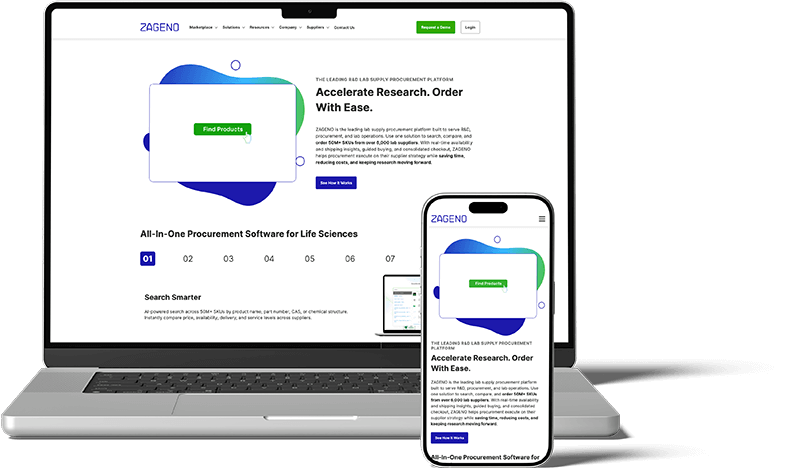

Editor’s note: Better lab procurement decisions depend on visibility into current inventory and consumption, storage capacity, expiration dates, safety requirements, and compliance obligations. The ZAGENO–SciSure integration connects procurement activity with chemical inventory data, bringing that information into the purchasing process. We invited Jon Zibell, Vice President of Global Alliances & Marketing at SciSure, to explain what procurement teams should know before an order is placed.
Procurement and the lab are operationally linked, whether your systems acknowledge it or not.
The purchase order doesn’t end at delivery. Rather, it sets off a chain of events inside the lab: safe storage decisions, consumption patterns, expiration clocks, compliance requirements, and training obligations. These are things procurement rarely sees and almost never factors into the next order.
That gap is expensive and not in a theoretical way. Rather, it turns up in a “We just disposed of $20,000 worth of expired reagents, and nobody flagged the reorder trigger” kind of way.
If you’re a procurement professional or a LabOps leader trying to close the loop between your ordering system and what’s actually happening on the bench, here's the specific inventory and operations data that should inform every purchase decision before you click “order.”
The five data points that should travel with every order request
“How quickly is the lab actually using what it orders?”
Most procurement teams are working from historical order frequency, meaning they reorder when someone asks, or when a standing order comes due, or when a researcher notices the shelf is empty. None of those signals reflect how fast material is actually being consumed under current conditions.
Consumption velocity, the real usage rate per week or per experiment cycle, is the number that determines whether a bulk purchase makes sense, whether a smaller standing order should replace it, or whether usage has dropped so significantly that you're going to be staring at a shelf full of materials you no longer need.
When sample management software tracks sample quantities tied to active experiments, that data exists. The problem is that this data rarely gets surfaced to procurement in a structured, usable form.
A connected workflow changes that. Procurement can see not just "how much do we have" but "at what rate are we going through it, and what does that mean for timing?"
That's the difference between reactive replenishment and intelligent forecasting.
“Where is this material going to go?”
I've watched procurement teams place bulk orders for temperature-sensitive reagents without any confirmation that available freezer space exists. The materials arrive; the lab scrambles. Samples are moved to accommodate the new inventory. Storage maps become inaccurate. Some materials end up in suboptimal conditions and compromise downstream work.
Storage availability is a real operational constraint, and it's a data point that exists in lab inventory systems, provided those systems are being maintained accurately. With SciSure, storage units, compartments, and capacity are trackable down to the position level. But that data doesn't automatically feed into a procurement workflow unless the systems are connected.
For high-volume labs, this is especially critical. Knowing that a -80°C freezer is 90% full before ordering another pallet of frozen materials is a hard operational requirement, not a nice-to-have. With the right tools, you can also track expired samples or chemicals in real-time, so you can maintain accurate inventory within your Maximum Allowable Quantities (MAQ) and energy consumption limits.
“Do we have stock of this item, and how long does it have before it expires?”
Procurement decisions can end up creating the most silent waste when reordering materials that are already in stock but are approaching expiration.
This happens more than most labs want to admit. You have a standing order for a reagent. The order triggers. The new batch arrives. Somewhere in a different storage unit sits the original stock, which was only partially consumed, and which has an expiration date six weeks out. Nobody connected those two facts. Now you have excess material with a short shelf life; the new stock won't be touched until the original is depleted (if the lab is diligent), and the likelihood of a disposal event is climbing.
Expiration data is something SciSure tracks natively at the sample and container level, with automated reminders and visual warnings configurable around approaching dates.
But that information has to be visible to procurement, or at minimum to a LabOps manager who is part of the procurement approval workflow, before the order is confirmed, not after it arrives.
“How hazardous is this material and where should it be stored?”
Not every lab operates under the same chemical safety rules. Not every facility has the same storage infrastructure. And not every procurement decision accounts for what it actually takes to receive, store, and use hazardous material safely. This is where the EHS side of the conversation becomes procurement relevant.
For example, if a lab is ordering a new flammable solvent, does procurement know that the receiving space is already at or near its MAQ for flammables? If a controlled substance is being reordered, has the required regulatory documentation been confirmed? If a chemical requires segregated storage away from oxidizers, is that space available and properly configured?
SciSure's Health & Safety features (including ChemTracker) maintain container-level chemical inventory with hazard classification, storage location, regulatory data, and SDS records. That's the system of record for what's in the lab and what regulatory obligations apply to it. When procurement is operating without access to that context, they're placing orders into a compliance environment they can't see.
A connected procurement-to-EHS workflow means that hazard requirements and current inventory quantities inform the order before it's placed, not after a safety officer flags an issue during a quarterly inspection.
Regulatory Status and Controlled Substance Tracking
Certain materials carry procurement requirements beyond standard ordering workflows. Controlled substances, select agents, radioisotopes, and other regulated materials require authorization records, purchase approvals, usage logs, and in some cases direct reporting to regulatory bodies.
In disconnected systems, these requirements are managed through a combination of manual checks, email chains, and institutional memory. Someone in procurement knows which items require sign-off. Someone in the lab knows that the authorization is current. Someone in compliance knows when the reporting window is. But nobody has a live view of all three simultaneously.
In a connected system, radioisotope and controlled substance workflows are designed to tie authorization status, order history, and usage records together within a governed system. That integration means procurement can verify regulatory status before an order is placed, reducing the risk of ordering a material whose authorization has lapsed, whose usage is approaching a threshold, or whose documentation trail has a gap.
The real cost of acting without this data
When procurement places orders without this context, the impact is rarely dramatic, but rather quiet, cumulative, draining time, money, and resources down the line.
For example, a reagent gets reordered while existing stock is only partially expired. The new batch pushes the old batch to the back of the shelf. The expired stock gets flagged during an inventory reconciliation six months later. It gets disposed of, and this disposal costs money. The materials cost money. The time spent managing the event costs money. The environmental impact should also have been avoided.
Multiply that across a mid-size research organization running dozens of active projects with hundreds of line items cycling through procurement, and you're not talking about isolated incidents. You're talking about a structural risk embedded in how the lab and procurement operate as separate systems.
What a connected workflow looks like instead
For example, a researcher wants to submit an order request for a new solvent the lab hasn't ordered before.
- Current chemical inventory and storage data are checked against MAQ levels, including expired samples or chemicals in real-time.
- They confirm that the receiving space is at 85% of its allowable limit for flammables.
- The order is approved, but LabOps is notified to confirm storage placement before receiving it.
- The SDS is pre-matched. The hazard requirements are documented in the system before the material arrives.
This scenario doesn’t require a full-scale digital transformation.
They just need connected systems and a procurement workflow that checks inventory and EHS data as a standard pre-order step.
SciSure's platform is designed to support this kind of integration, tracking consumption, storage, expiration data, and automatically logging it into the proper regulatory report.
Likewise, ChemTracker maintains chemical inventory, hazard records, and SDS matching, while our API and integration architecture supports connections to procurement platforms like ZAGENO.
The data needed to make smarter procurement decisions exists in these systems. The question is whether it's being surfaced at the right point in the workflow.
A practical starting point
If you’re a procurement or LabOps leader reading this and thinking "We're not even close to having this kind of data flow," here are three questions worth answering before your next major order cycle:
- Do you know your current stock levels and expiration dates for your top 20 most frequently ordered items?
If not, that's the first inventory data gap to close. - Does your procurement approval workflow include a step where a LabOps or EHS team member confirms storage availability and regulatory status?
If not, that's a process gap that can be addressed before any system integration work begins. - Are your inventory and EHS systems connected to your procurement platform in any structured way?
Or are they separate systems that communicate through email and spreadsheets? The answer to that question tells you exactly how much visibility you're currently missing.
These questions help you figure out your operational readiness, right from the get-go. The answers will tell you about how much preventable waste and compliance exposure is sitting in your current procurement process.
If you’re evaluating how connected your procurement and lab operations workflows are, inventory is a logical place to start. The ZAGENO–SciSure integration automatically syncs procurement activity with chemical inventory, reducing manual work, improving inventory accuracy, and giving research teams a more connected workflow from ordering to the lab.
About the author
Jon Zibell is Vice President of Global Alliances & Marketing at SciSure, where he leads strategic partnerships with organizations like The Engine (MIT), My Green Lab, and Safety Partners to help life science and research institutions modernize lab operations and compliance. He writes about the operational, safety, and technology challenges facing modern scientific organizations. Jon holds a B.S. in Marketing & Corporate Communications from Bentley University.

Connect procurement with the way research actually works
See how ZAGENO connects scientific procurement with the systems, suppliers, and workflows that support pharmaceutical and biotech R&D.