
What biotech teams are discovering about lab purchasing workflows—and how one company returned 250+ hours to science.
Biotech labs have modernized nearly every aspect of discovery. Automation platforms run high-throughput experiments, advanced data infrastructure supports complex analysis, and AI identifies drug targets. Yet, while science has surged ahead, procurement workflows in many organizations have lagged, creating a productivity gap that leading labs are now moving to close.
The science of speed: Why procurement is a research productivity metric
Slow procurement forces scientists to manage administrative tasks instead of conducting experiments. As discussed in ZAGENO’s guide to lab supply purchasing, siloed ordering processes introduce delays long before a scientist ever touches a pipette.
The hidden bottleneck: Why procurement is no longer "back-office"
While traditionally viewed as a separate administrative function, procurement is actually a primary driver of research timelines. Internal research across life sciences organizations shows how critical these frustrations have become:
- 67% of lab professionals would not recommend their current ordering process.
- Nearly 9 in 10 researchers report experiment delays due to backorders.
These challenges, explored in ZAGENO’s overview of life sciences procurement, illustrate how breakthroughs are sidelined when scientists must spend their day searching catalogs, comparing prices, and chasing routine internal approvals.
Case study: How Apogee Therapeutics returned 250+ hours to science
Apogee Therapeutics is a prime example of a leading lab that traded decentralized purchasing for a streamlined, productivity-first model. As their research programs expanded, managing lab supply purchasing across multiple teams became a significant operational hurdle.
By implementing a centralized procurement environment through ZAGENO, Apogee transformed their workflow with measurable results in the first year:
|
Metric
|
Operational Impact
|
|---|---|
|
Time Reclaimed
|
250+ hours returned to scientists
|
|
PO Efficiency
|
40% fewer purchase orders processed
|
|
Centralization |
98 suppliers managed in one portal |
|
Cost Savings |
$260,000+ in estimated time savings |

Industry momentum: From administration to strategy
Across the life sciences ecosystem, procurement is evolving into a strategic enabler of productivity. This shift is more than an administrative upgrade; it is a strategic trade. By moving away from fragmented systems, labs are gaining the "speed to data" required in a competitive biotech landscape.
This trend was recently highlighted in Entrepreneur UK, featuring ZAGENO’s perspective on how digital lab marketplaces help organizations eliminate the "efficiency tax" by centralizing catalogs, availability, and approvals.
Is your procurement process slowing you down?
To reclaim research time, evaluate your current workflow with these four questions:
- How much time do researchers spend sourcing supplies weekly?
- How many individual supplier portals must our team maintain?
- How often do manual PO errors or backorders delay an active experiment?
- Is our procurement data visible to both finance and the bench?
Even modest improvements can free up meaningful time for discovery. In the race for scientific breakthroughs, every hour matters.
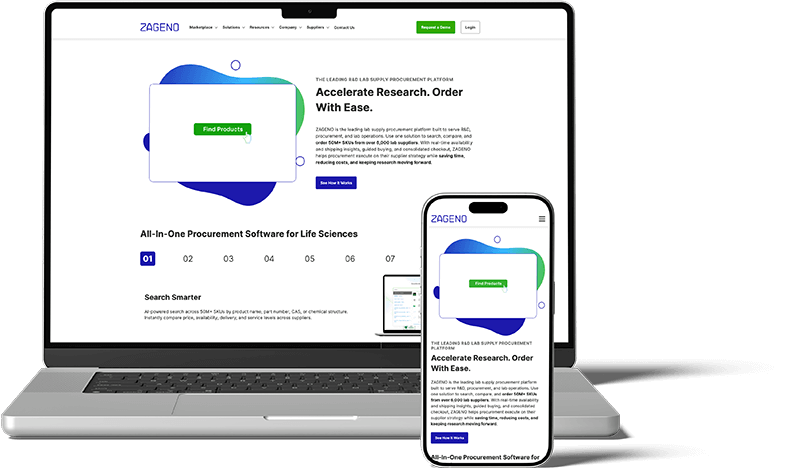
Stop the research drain: Optimize your lab with ZAGENO
Don’t let manual data entry and fragmented portals be the bottleneck in your next breakthrough. Join industry leaders like Apogee Therapeutics in shifting procurement from a back-office task to a strategic research advantage.
Streamline your lab: Schedule a consultation to identify and eliminate your procurement bottlenecks.
Frequently asked questions (FAQ)
-
How does procurement affect research productivity?
Procurement determines the lead time for essential materials. When workflows are fragmented, researchers spend time on coordination rather than experiments, effectively slowing the "time to data." -
Why do procurement delays slow scientific research?
Scientific research is linear; missing one reagent can halt an entire project. Delays in ordering or backorder notifications often force scientists to postpone or redesign experiments. -
How can biotech labs reduce time spent ordering supplies?
Centralizing the "search, shop, and pay" process into a single digital marketplace allows researchers to compare vendors and check availability in one place, reducing administrative overhead. -
How many suppliers do research labs typically work with?
Most mid-to-large labs work with dozens or hundreds of suppliers. Without a centralized platform, managing these individual relationships creates a massive administrative burden. -
What causes the most significant delays in lab supply procurement?
The primary culprits are manual approval chains, lack of real-time inventory visibility, and the time required to switch between disparate supplier websites.
Related resources