


Procure-to-pay (P2P) workflows in biotech and pharma are significantly more complex than traditional corporate purchasing processes. Research organizations must coordinate scientific purchasing, supplier management, finance controls, compliance documentation, and inventory planning across fragmented supplier ecosystems.
Improving P2P performance is not simply about processing purchase orders faster; it directly affects research continuity, budget visibility, audit readiness, and operational efficiency across R&D and finance teams.
This guide explores operational best practices for improving P2P workflows in life sciences and reducing the procurement bottlenecks that commonly slow research organizations.
For an overview of how the procure-to-pay lifecycle works in biotech and pharma organizations, see our guide to procure-to-pay in life sciences.
Why P2P workflows are more challenging in life sciences
Many procurement systems were originally designed for standardized enterprise purchasing environments, but life sciences organizations operate differently.
- Specialized needs: Scientists routinely require niche reagents, low-volume materials, or highly specific equipment that falls outside traditional purchasing contracts.
- Fragmented ecosystems: Organizations often manage dozens, hundreds, or thousands of supplier PunchOut catalogs simultaneously, creating administrative overhead and interface inconsistency.
- Strict compliance: Teams must navigate rapidly changing research priorities while maintaining strict compliance and documentation standards.
Many organizations struggling with fragmented supplier ecosystems eventually prioritize centralized sourcing and supplier consolidation strategies to improve visibility and operational control.
Common P2P bottlenecks in biotech and pharma
Research-driven environments frequently experience recurring inefficiencies that reduce visibility and create delays across both procurement and scientific operations.
Best practices for optimizing P2P in life sciences
To transition procurement from a reactive function to a strategic advantage, organizations typically adopt these best practices:
How ERP systems fit into modern P2P workflows
ERP systems play an important role in financial governance by supporting invoice processing, payment workflows, general ledger controls, and financial reporting.
However, sourcing workflows, supplier comparison, and scientific purchasing frequently occur outside the ERP layer. This creates operational gaps between procurement execution and financial systems.
As a result, many biotech and pharma organizations integrate procurement orchestration and supplier management platforms alongside ERP infrastructure to improve workflow coordination and strengthen ERP and procurement integrations across sourcing and finance systems.
The role of ERP systems and KPIs
While ERP systems provide essential financial governance like accounts payable and general ledger controls, scientific sourcing and supplier comparison often occur outside the ERP layer. Many organizations integrate procurement orchestration platforms alongside ERP infrastructure to bridge this gap.
To measure the success of these optimizations, procurement leaders should monitor the following KPIs:
- Purchase order cycle time
- Invoice exception rate
- Supplier onboarding time
- 3-way matching efficiency
- On-contract spend percentage
How automation and AI are improving procurement workflows
Modern procurement platforms increasingly use automation and AI-assisted workflows to improve approval routing, invoice processing, supplier coordination, and spend visibility across procurement operations.
In life sciences environments, these capabilities help procurement teams reduce administrative burden while improving purchasing consistency and operational forecasting across research workflows.
As procurement environments become more complex, organizations are increasingly exploring workflow orchestration and automation technologies that improve sourcing visibility and strengthen procurement coordination across research operations.

Real-world Results: Biotech procurement automation
A 54-person biotech company modernized its procurement workflow by implementing a centralized sourcing workflow integrated with its ERP.
-
Financial Impact: Achieved $326,575 in labor savings.
- Efficiency Gains: Saved 3,585 hours and improved approval flow coordination.
-
Operational Success: Reached 91% on-time order delivery and improved spend visibility.
Frequently asked questions (FAQs) about P2P in Life Sciences
-
What are P2P best practices in biotech and pharma?
P2P best practices include automating approval workflows, improving spend visibility, reducing supplier fragmentation, and standardizing invoice reconciliation. -
Why is P2P more complex in life sciences?
It involves specialized suppliers, regulated workflows, scientific exceptions, and fragmented sourcing environments that exceed standard corporate purchasing complexity. -
What are common P2P bottlenecks in biotech?
Common issues include approval delays, manual invoice matching, supplier onboarding inefficiencies, and limited spend visibility. -
How do ERP systems support P2P workflows?
ERP systems manage financial controls and payments, while sourcing and supplier coordination are often handled through specialized procurement orchestration platforms.
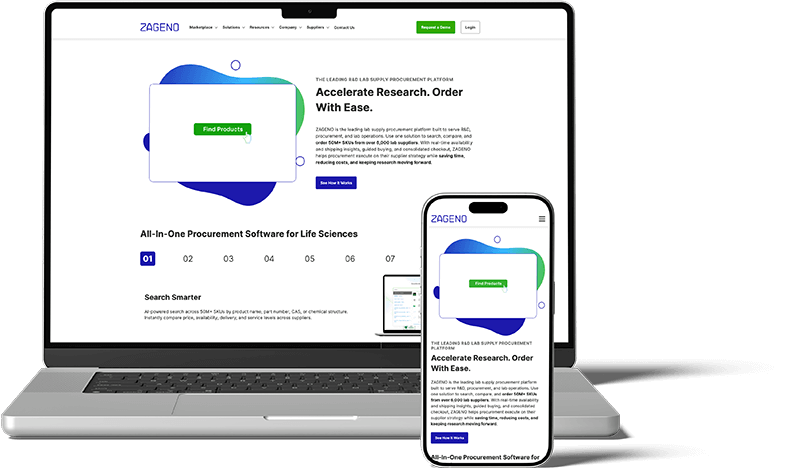
Improve P2P performance today
ZAGENO helps life sciences organizations centralize supplier access, improve procurement visibility, and automate purchasing workflows. Strengthen the coordination between your sourcing and finance systems to support research continuity.