

Sequencing workflows are only as reliable as the suppliers behind them.
Most labs don’t rely on just one vendor for sequencing kits and reagents. Instead, they’re juggling a mix of suppliers across library prep kits, enzymes, buffers, and sequencing platforms. That flexibility is useful, but it can also introduce inconsistency, delays, and excessive administrative burden that pulls scientists away from the bench.
If your team is evaluating new vendors or trying to standardize purchasing, the goal isn’t simply to find “the best” supplier. It’s to compare sequencing suppliers in a way that actually fits your workflows, timelines, and procurement requirements.
How do labs compare sequencing suppliers?
To compare sequencing suppliers, labs evaluate five factors:
- Workflow compatibility
- Product availability
- Pricing consistency
- Supplier reliability
- Procurement efficiency
The most effective approach is to assess these side by side across multiple suppliers to ensure consistency, reduce delays, and standardize purchasing across labs and sites.
Why comparing sequencing suppliers is more complex than it looks
At first glance, comparing suppliers seems straightforward. Check the price, confirm availability, and place the order.
In reality, sequencing procurement is more nuanced.
Different suppliers may offer:
- Slightly different protocols or kit formats
- Variations in reagent quality or consistency
- Different lead times depending on region or stock
- Separate ordering systems and approval processes
As a result, two suppliers with similar products can create quite different outcomes for your lab.
That’s why supplier comparison needs to go beyond product specs and take a more structured approach.
For a technical overview, the National Human Genome Research Institute provides a helpful sequencing fundamentals reference.
What should you look for when comparing sequencing suppliers?
| Comparison Factor | Technical Impact | Procurement Impact |
|---|---|---|
| Workflow Fit | Ensures data reproducibility | Reduces protocol waste/errors |
| Availability | Protects project timelines | Eliminates emergency spot-buying |
| Pricing | Maintains budget integrity | Simplifies approval cycles |
| Reliability | Consistent reagent quality | Fewer returns or failed runs |
| Workflow | More time for high-value research | Centralized invoicing & tracking |
Common challenges labs face when comparing suppliers
If this all sounds familiar, you’re not alone. Most labs run into the same issues:
- Switching between many supplier websites
- Difficulty comparing pricing and availability
- Inconsistent product choices across teams
- Delays tied to approval processes
- Limited visibility into past orders and supplier performance
These challenges make it harder to move quickly and make consistent, informed decisions.
How centralized sourcing changes supplier comparison
Instead of comparing suppliers one by one, many labs are moving toward centralized sourcing.
With a centralized approach, teams can:
- view multiple sequencing suppliers in one place
- compare availability and pricing side by side
- standardize product selection across projects
- streamline approvals and ordering
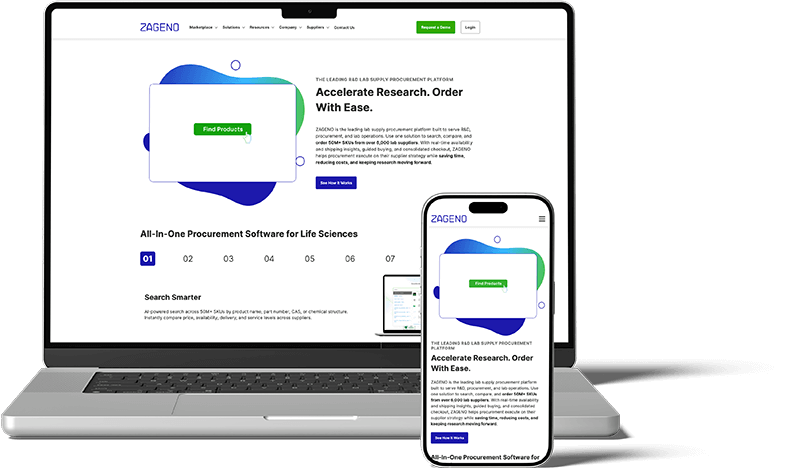
Lab procurement platforms like ZAGENO make this possible by connecting labs to thousands of suppliers through a single interface. This allows teams to evaluate options and manage purchasing without navigating multiple systems.
What is the best way to compare sequencing suppliers?
A structured approach helps teams make consistent decisions:
- Define workflow requirements
- Shortlist compatible suppliers
- Compare pricing, availability, and reliability
- Evaluate procurement impact
- Standardize sourcing decisions
Teams that align these steps with structured lab procurement workflows are better positioned to scale, while maintaining consistency.
FAQ: Comparing sequencing suppliers
- How do labs evaluate sequencing suppliers?
Labs evaluate sequencing suppliers by looking at workflow compatibility, availability, pricing consistency, supplier reliability, and how easy procurement is to manage. Together, these factors help reduce delays and improve consistency. - What is the difference between sequencing suppliers and general lab suppliers?
Sequencing suppliers specialize in products used for genomic workflows, such as library preparation kits, enzymes, and sequencing reagents. General lab suppliers may provide a broader range of consumables and equipment but may not offer the same depth in sequencing-specific products. - Why is sequencing procurement more complex than general lab purchasing?
Sequencing procurement involves coordinating multiple specialized suppliers, managing workflow compatibility, and ensuring consistent reagent quality. These requirements make it more complex than general lab purchasing, which often involves standardized consumables. - How can labs standardize sequencing supplier selection?
Labs can standardize supplier selection by defining preferred vendors, aligning purchasing workflows across teams, and using centralized systems to compare and track supplier performance over time. - How does centralized sourcing improve supplier comparison?
Centralized sourcing makes it easier to compare sequencing suppliers side by side, improves visibility into pricing and availability, and reduces the effort required to manage multiple vendor systems.
Moving from ad hoc comparison to consistent sourcing
Comparing sequencing suppliers isn’t just about finding the right product. It’s about finding the right combination of product, availability, and procurement fit.
Labs that take a more structured approach to supplier comparison can:
- reduce delays
- improve consistency
- spend less time managing orders
- scale more effectively
As sequencing workflows become more complex, the way labs evaluate and manage suppliers becomes just as important as the science itself.
Related resources