

Procurement in biotech and life sciences is anything but simple. Unlike office supply or MRO purchasing, R&D teams source specialized lab supplies, from consumables and reagents to instruments, across hundreds of suppliers while balancing speed, compliance, and budget controls. To manage this complexity, many organizations rely on lab punchout catalogs.
Punchout catalog definition
A punchout catalog is an eProcurement integration method that connects a supplier’s online catalog directly to an organization’s ERP or purchasing system. Using protocols such as cXML or OCI, it allows users to browse live supplier pricing and availability, build a cart, and return that cart to their procurement system for approval and purchase order generation.
Punchout catalogs are used across many industries, including manufacturing, healthcare, and higher education. In life sciences and lab procurement, they are typically implemented to preserve negotiated pricing, enforce approval workflows, and maintain compliance inside ERP systems such as Coupa, SAP, Ariba, Oracle, Jaggaer, or NetSuite.
While punchout catalogs are commonly used in lab procurement, they are often misunderstood. A punchout catalog is a transactional connection method, not a complete procurement solution. It works well for individual supplier relationships, but it was not designed to coordinate sourcing, approvals, or purchasing across dozens or hundreds of vendors in R&D environments.
This guide explains what lab punchout catalogs are, how they work technically, where they fit in life sciences procurement, and when labs need additional infrastructure to support scalable procure-to-pay workflows.
Looking for a quick answer? Jump to the punchout catalog FAQs below for a concise breakdown, or continue reading for a deeper explanation of how punchout works in lab procurement.
How lab punchout catalogs work in life sciences procurement
In life sciences environments, a lab punchout catalog connects your organization’s ERP or procurement system to a strategic supplier’s live catalog while preserving contract pricing, approval workflows, and compliance controls specific to R&D purchasing. Instead of logging into supplier websites separately or uploading static spreadsheets, users “punch out” from the ERP into the supplier’s site, shop with contract pricing, and return the cart to the procurement system for approval.
Punchout catalogs are commonly used to:
- Enforce negotiated pricing
- Maintain compliance and auditability
- Reduce manual data entry
- Support structured lab procure-to-pay processes
Is a lab punchout catalog the same as a procurement platform?
In lab and life sciences procurement, the answer is no. A punchout catalog is not a category of procurement software. It is a catalog connection method that enables access to individual supplier catalogs and passes cart data back into an ERP or purchasing system.
Punchout catalogs support transactions with individual suppliers, but they do not manage sourcing, approvals, or purchasing across multiple lab suppliers.
In short: punchouts support supplier transactions. Procurement platforms coordinate lab purchasing across suppliers.
Because of these limitations, punchout catalogs are best understood as one piece of a broader procurement setup. This is why many labs layer a procurement platform on top of their ERP and punchout catalogs, rather than relying on punchouts alone.
How punchout catalogs work in lab procurement systems
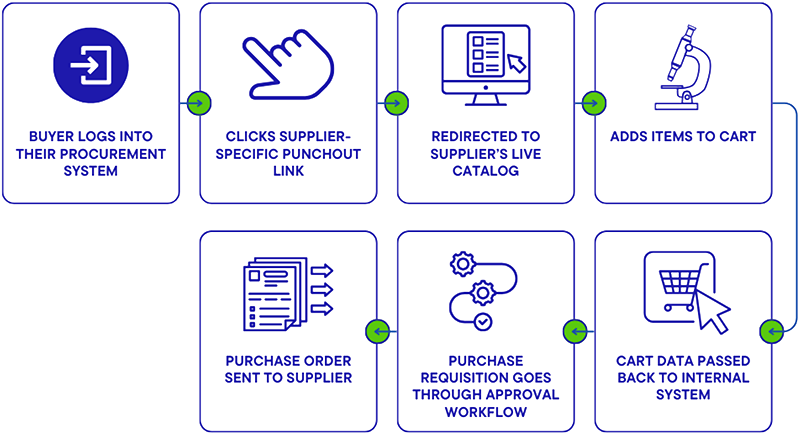
Typical workflow:
- Log into your procurement system (Coupa, Ariba, Oracle, Jaggaer, NetSuite).
- Click the supplier’s punchout link.
- Browse the live catalog with your pricing.
- Build a cart.
- Cart data passes back to the ERP.
- Normal approvals apply.
- A purchase order is generated and sent to the supplier.
Punchout catalogs improve accuracy and reduce errors, but each supplier requires its own technical integration, testing, and ongoing maintenance. As labs grow, this can slow down purchasing and introduce friction across ERP-based lab procurement workflows.

For a broader look at how labs structure purchasing workflows beyond individual supplier catalogs, see our Complete Lab Purchasing Guide.
What is cXML in punchout catalog integrations?
Most punchout catalog integrations rely on cXML (Commerce eXtensible Markup Language), a standardized protocol used to securely transmit catalog and order data between suppliers and ERP systems.
When a user clicks a punchout link inside an ERP:
- The ERP sends a cXML request to the supplier’s system.
- The supplier authenticates the session and loads the live catalog.
- After items are added to the cart, cXML transmits the cart data back to the ERP.
- The ERP converts the cart into a requisition or purchase order for approval.
Because each supplier punchout requires its own configuration, credentials, and testing cycle, IT teams must validate pricing files, units of measure, UNSPSC codes, and ship-to information before go-live.
In lab environments with many suppliers, this technical overhead can grow quickly as vendor count increases.
Note: Some ERP systems, particularly SAP environments, may use OCI (Open Catalog Interface) instead of cXML for punchout integrations.
Hosted vs. punchout catalogs
Hosted catalogs were an early step toward digital procurement, but they rely on static data that quickly becomes outdated. Punchout catalogs replaced hosted catalogs by providing real-time pricing and availability, but neither approach alone addresses the full complexity of R&D procurement.
|
Feature
|
Hosted Catalog
|
Punchout Catalog
|
|---|---|---|
|
Data refresh
|
Manual, periodic
|
Real-time, live
|
|
User experience
|
ERP-native
|
Supplier’s website
|
|
Pricing
|
Often static
|
Contract-based, dynamic
|
|
Inventory visibility
|
Limited
|
Real-time
|
|
Maintenance owner
|
Buyer
|
Supplier
|
Key takeaway: Punchout catalogs improve access to supplier catalogs. They do not function as lab procurement platforms.
Punchout catalog meaning in lab procurement
In general procurement, a punchout catalog refers to a technical catalog access method used within ERP-based purchasing systems. It does not imply a sourcing strategy, supplier consolidation model, or workflow optimization tool.
In lab and life sciences procurement, the meaning is more specific. A lab punchout catalog:
- Connects one supplier at a time into the ERP
- Preserves contract pricing and approval workflows
- Maintains compliance documentation within purchasing controls
What it does not do is coordinate sourcing across dozens or hundreds of vendors.
That distinction is important. A punchout catalog is a connection mechanism. A procurement platform is an orchestration layer.
As R&D organizations scale supplier networks, the difference between those two concepts becomes operationally significant.
The complexity of lab procurement and where punchout catalogs fit
R&D procurement introduces challenges that do not exist in general purchasing:
- Volatile supply chains where availability changes rapidly
- Extremely high SKU counts across many categories
- Documentation requirements such as SDS, COAs, and compliance records
- The need to balance scientific speed with procurement controls
Punchout catalogs help by providing real-time product data and preserving approval workflows. What they do not address is supplier sprawl, longtail sourcing, or fragmented order tracking. As labs expand research programs and vendor networks, these gaps become harder to manage without additional procurement infrastructure.
The five biggest challenges with multiple lab punchout catalogs
Punchout catalogs work best when labs rely on a small number of strategic suppliers. Once supplier count grows, those same punchouts often introduce new problems:
- Complex integrations → Every punchout catalog requires IT setup, testing, and maintenance.
- Inconsistent user experience → Every supplier’s catalog behaves differently.
- Limited supplier coverage → Many niche vendors do not offer punchout catalogs, forcing workarounds and increasing maverick spend.
- Fragmented tracking → Labs waste time checking multiple portals for status updates.
- Administrative overload → Multiple POs, invoices, and contracts.
ZAGENO survey data shows:
- 67% of scientists and lab ops would not recommend their current lab supply ordering process.
- 90% reported delays caused by unavailable or backordered items.
Troubleshooting common lab punchout catalog issues
Labs frequently encounter integration and workflow issues with punchout catalogs.
|
Issue
|
Symptom
|
Likely Cause
|
Fix / Owner
|
|---|---|---|---|
|
Price mismatch
|
Cart shows wrong pricing
|
Contract not synced
|
Supplier updates file
|
|
Cart fails to return
|
Items don’t load into ERP
|
cXML/OCI error
|
IT + Supplier support
|
|
Duplicate line items
|
Double entries in requisitions
|
Mapping misalignment
|
Re-map item codes
|
|
Unit of measure conflict
|
Order rejects at ERP stage
|
UoM mismatch
|
Buyer + IT validate
|
|
Ship-to errors
|
Wrong facility/site in order
|
Address config missing
|
ERP admin adds site
|
|
Timeout or SSO loop
|
User can’t punch out
|
Authentication error
|
IT + ERP team reset
|
|
Order not transmitted
|
Supplier never receives PO
|
Workflow stuck post-approval
|
ERP workflow check
|
Tip: Labs should use a punchout test checklist covering units of measure, GL codes, UNSPSC codes, contract pricing, and ship-to addresses before go-live.
Punchout catalogs vs multi-supplier lab procurement platforms
Supplier punchout catalogs improve compliance within individual vendor relationships. They were not designed to manage sourcing across dozens or hundreds of suppliers.
Multi-supplier lab procurement platforms complement punchout catalogs by centralizing sourcing and ordering across the supplier ecosystem.
This distinction matters because punchout catalogs and procurement platforms solve fundamentally different problems in lab purchasing.
|
Feature
|
Punchout Catalog
|
Procurement Platform (ZAGENO)
|
|---|---|---|
|
Supplier coverage
|
Limited
|
Thousands of suppliers
|
|
Checkout
|
One PO per supplier
|
One PO across suppliers
|
|
Non-catalog sourcing
|
Rare
|
Fully supported
|
|
Setup effort
|
High
|
Minimal
|
|
Tracking
|
Supplier by supplier
|
Unified view across suppliers
|
Punchout catalogs solve inefficiencies inside a supplier relationship. Procurement platforms solve inefficiencies across supplier relationships.

For teams evaluating alternatives to supplier-by-supplier punchout, this guide on how to choose a lab supply marketplace outlines key considerations.
Supplier punchout vs platform-based punchout
Not all punchout models are the same.
- Supplier punchout connects one supplier at a time into the ERP
- Platform-based punchout connects a procurement platform into the ERP, providing access to many suppliers through one entry point
For R&D organizations managing longtail and niche suppliers, platform-based punchout reduces repeated IT work while preserving ERP-level controls and compliance.
Guided buying and lab punchout catalogs
With multiple punchout catalogs in play, scientists often struggle to know where to buy the right product. Product data is fragmented, comparisons are manual, and procurement teams are pulled into routine sourcing questions that slow research.
Guided buying addresses this by applying rules and recommendations directly into the purchasing workflow.
With ZAGENO, guided buying supports:
- Steering users toward preferred suppliers and pricing
- Automatic mapping to cost centers, GL codes, and projects
- Customizable budget thresholds that streamline approvals
- Rebate optimization through preferred vendor routing
- Metacart checkout that consolidates items from multiple suppliers
This approach improves the buying experience while preserving procurement controls and ERP integration.

A deeper comparison of procurement approaches is covered in our biotech procurement solution comparison.
Procurement KPIs for evaluating lab punchout catalogs
To assess effectiveness, labs should monitor:
- Time to requisition
- Percentage of spend off-catalog
- PO cycle time
- Percentage of orders delayed due to backorders
- Suppliers per cart and per invoice
- Scientist time spent searching for products
These measures show how well punchouts support purchasing inside individual supplier relationships. For a broader view of scientist time, workflow performance, supplier adoption, spend control, and order reliability, see our guide to procurement KPIs for pharmaceutical R&D.
When lab punchout catalogs fit and when you need more
Punchout catalogs fit when:
- Spend is concentrated with a few suppliers
- Product requirements are relatively stable
Labs need more when:
- Supplier count grows into the hundreds
- Scientists spend excessive time searching across punchouts
- Finance teams require consolidated POs and invoices
- New or niche suppliers must be onboarded quickly
How ZAGENO simplifies lab punchout catalog management
ZAGENO reduces the operational burden of managing multiple lab punchout catalogs by acting as a single procurement layer between your ERP and suppliers.
ZAGENO provides:
- One punchout connection into Coupa, Ariba, SAP, Oracle, or NetSuite
- Access to over 40M SKUs from more than 5,000 suppliers
- Metacart checkout with one PO and one invoice
- Supplier onboarding in weeks instead of months
- AI-driven insights for availability, delivery, and cost optimization
Making sense of lab punchout catalogs
Lab punchout catalogs play an important role by connecting procurement systems to strategic suppliers. They help preserve approvals, pricing, and compliance, but they were not designed to manage the full complexity of R&D sourcing. As supplier networks grow and product needs change, labs often need additional flexibility, consolidation, and visibility across vendors.
That’s where broader procurement platforms come into play, helping teams apply these concepts consistently across suppliers while keeping existing ERP and P2P workflows intact.

See how labs bring these pieces together.
ZAGENO helps teams combine punchout compliance with flexible sourcing through a single procurement platform.
Lab punchout catalog FAQs
-
What is a punchout catalog in lab procurement?
A punchout catalog is a connection between a supplier’s online catalog and a procurement or ERP system. It allows users to access live pricing and availability, build a cart on the supplier’s site, and return that cart to their procurement system for approval and purchase order creation. -
How does a punchout catalog work in lab procurement?
In a typical workflow, a user logs into their procurement system, selects a supplier punchout link, and is redirected to the supplier’s catalog with contract pricing. After building a cart, the data is sent back to the ERP, where standard approval workflows apply and a purchase order is generated. Each supplier requires its own integration, which can increase complexity as vendor count grows. -
Is a lab punchout catalog the same as a procurement platform?
No. A punchout catalog is a connection method that enables transactions with a single supplier. A lab procurement platform coordinates sourcing, purchasing, and supplier management across many vendors. Punchout catalogs support individual supplier relationships, while procurement platforms manage the broader lab purchasing ecosystem. -
What are the benefits of a punchout catalog for labs?
Punchout catalogs provide real-time pricing and availability directly within procurement systems, reduce manual data entry, and help enforce contract pricing and approval workflows. They are particularly effective for managing purchasing with strategic suppliers inside ERP-driven processes. -
Why are punchout catalogs limited for labs?
Punchout catalogs are limited because they operate one supplier at a time. Each supplier requires its own integration, user experience varies across catalogs, and labs often need to navigate multiple systems to complete purchases. As supplier networks grow, this can lead to fragmented workflows and increased administrative effort. -
Can labs use punchout catalogs with multiple suppliers?
Yes, but each supplier requires a separate punchout integration, configuration, and maintenance cycle. As the number of suppliers increases, this approach can become difficult to manage and may slow down purchasing workflows. -
When should labs use a procurement platform instead of punchout catalogs?
Labs typically consider a procurement platform when they work with many suppliers, need to compare options across vendors, or want to consolidate purchasing into fewer purchase orders and invoices. In these cases, a broader life sciences procurement strategy helps coordinate sourcing and purchasing across the supplier ecosystem.
Related resources