

In biotech and pharma organizations, procurement is more complex than in most industries. Scientists and lab teams should not have to piece together workflows across disconnected supplier websites, email chains, and manual spreadsheets just to get the materials they need. P2P automation centralizes these activities, improving visibility, reducing manual tasks, and enabling more consistent purchasing decisions. According to McKinsey research on digital procurement, organizations implementing procurement automation can significantly reduce processing time and improve overall efficiency.
What is procure-to-pay in biotech and pharma?
Procure-to-pay (P2P) is the core workflow for day-to-day lab procurement. For a general overview, see this procure-to-pay definition. In life sciences organizations, this typically includes:
- Identification. Pinpointing lab supplies for experiments or operations.
- Request and approval. Submitting purchase requests and routing them based on specific budgets, projects, or cost centers.
- PO issuance. Converting approved requests into formal purchase orders.
- Receiving. Tracking shipments and confirming the delivery of goods.
- Reconciliation. Matching invoices against original orders and receipts.
- Settlement. Processing payments through integrated finance systems
How the procure-to-pay process works in life sciences
Once defined, the next step is to understand how the P2P process actually works in a life sciences environment. In biotech and pharma organizations, the workflow generally follows six steps:
These steps often involve additional complexity due to supplier fragmentation and coordination across teams. This is explored further in procurement inefficiencies in biotech workflows.
Procure-to-pay vs source-to-pay
Procure-to-pay (P2P) and source-to-pay (S2P) are related but distinct processes:
- Procure-to-pay (P2P) focuses on purchasing, ordering, invoicing, and payment.
- Source-to-pay (S2P) includes sourcing, supplier selection, and contracting in addition to P2P.
Why P2P is different in life sciences procurement
Life sciences procurement diverges from standard procure-to-pay models used in other industries. Biotech and pharma teams must manage:
- Specialized products. Scientific supplies with inconsistent naming and specifications.
- Fragmented networks. Supplier ecosystems spanning thousands of vendors.
- Non-catalog spend. Frequent purchasing of items not found in standard catalogs.
- Urgency. Requirements driven by time-sensitive experiments.
- Cross-team coordination. Alignment between scientists, procurement, lab ops, and finance.
These factors make procurement workflows more complex and require systems that support scientific purchasing, not just traditional procurement processes.
Benefits of P2P automation for lab teams
P2P automation improves procurement performance in biotech and pharma by:
- Reducing cycle time. Faster approvals and ordering workflows. See how this works in practice in how P2P improves procurement efficiency.
- Improving spend visibility. Better tracking of purchases and budgets, supporting improving spend visibility in biotech procurement.
- Minimizing manual work. Reducing the reliance on spreadsheets and manual approvals.
- Improving supplier coordination. Centralized communication and order tracking.
- Strengthening financial control. More accurate reconciliation through ERP and P2P integrations for biotech.
- Reducing costs. Gaining control over spend and reducing errors. Learn more in how P2P reduces procurement costs.
Challenges of P2P implementation
Common P2P challenges in life sciences include fragmented supplier ecosystems, incomplete capture of spend, and lack of integration between procurement and finance systems. Stakeholder adoption and inconsistent data also remain significant hurdles.
Commonly used P2P platforms include SAP Ariba, Coupa, Jaggaer, and Oracle Cloud Procurement. In life sciences, these are often complemented by solutions that better support lab-specific purchasing and supplier discovery.
Where ZAGENO fits in the P2P workflow
ZAGENO helps bridge the gap between structured procurement systems and the realities of lab purchasing. For biotech and pharma organizations, this includes:
- Easier discovery. Seamless product discovery across large supplier networks.
- Flexible purchasing. Single entry point for both catalog and non-catalog purchasing.
- Enhanced visibility. Improved order tracking and streamlined supplier coordination.
When these workflows are connected, finance teams improve accuracy while scientists spend less time managing orders and more time on research.
FAQs about P2P in life sciences
- What is procure-to-pay in life sciences?
Procure-to-pay (P2P) in life sciences is the process that connects purchasing and accounts payable for lab supplies, covering everything from product selection through invoice payment. - Why is procure-to-pay more complex in biotech and pharma?
Because procurement involves specialized products, fragmented suppliers, and coordination across scientists, procurement, and finance teams. - What are the benefits of P2P for biotech procurement teams?
P2P improves efficiency, increases spend visibility, reduces manual work, and helps manage lab supply purchasing more effectively. - What challenges are common in P2P implementation for life sciences?
Common challenges include system integration, supplier complexity, incomplete spend capture, and stakeholder adoption. - How does P2P support lab supply purchasing workflows?
P2P systems standardize ordering, approvals, invoice matching, and payment, making it easier to manage procurement across multiple suppliers and teams.
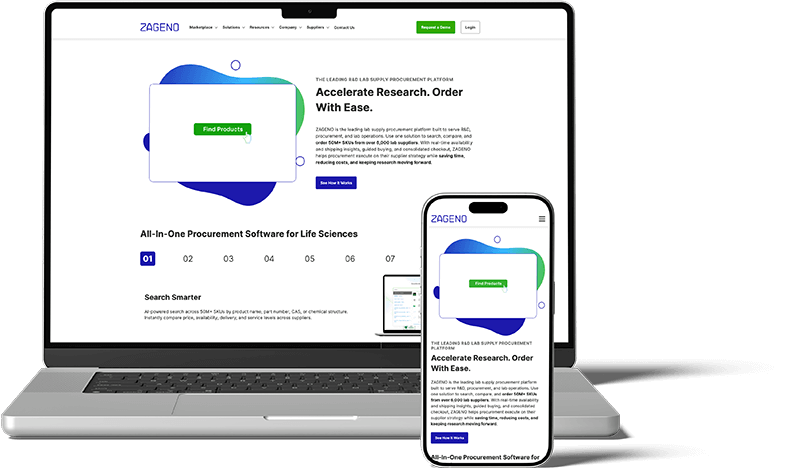
See how life sciences teams simplify procurement
Explore how ZAGENO helps biotech and pharma organizations streamline supplier sourcing across thousands of vendors and connect procurement, finance, and lab operations in one workflow.
Related resources