

Supplier consolidation (often referred to as vendor consolidation) is the strategic process of reducing and rationalizing the number of suppliers an organization purchases from in order to improve efficiency and lower costs.
In most industries, this is a straightforward cost-saving exercise. In life sciences, however, the stakes are higher, especially as part of a broader life sciences procurement strategy. For biotech and pharma organizations, consolidation directly impacts research velocity, experimental flexibility, and GxP compliance.
Scientists rely on highly specific products. Procurement teams need visibility and control. Supply disruptions can delay experiments. This challenge becomes even more pronounced in pharmaceutical organizations, where procurement must scale across global supplier networks while maintaining strict regulatory compliance. See how this fits into a broader pharma procurement strategy.
The challenge is not whether to consolidate suppliers, but how to do it without limiting scientific choice or slowing R&D.
What is supplier consolidation?
Supplier consolidation is the process of reducing the number of suppliers an organization uses while maintaining access to required products, improving cost control, and increasing visibility into procurement activities.
What is supplier consolidation in lab procurement?
In a lab environment, consolidation is less about eliminating vendors and more about centralizing the procurement experience.
It focuses on:
- Reducing fragmentation to simplify administrative burden.
- Maintaining access to specialized products required for research.
- Increasing visibility into total spend and supplier performance.
- Improving pricing leverage by strengthening core supplier relationships.
While consolidation typically improves pricing and vendor management, in biotech and pharma environments it must support scientific workflows rather than restrict them.
These constraints are often part of larger pharma procurement challenges, particularly as organizations manage supplier fragmentation at scale.
In regulated environments, supplier consolidation also plays an important role in improving procurement traceability, supplier governance, and audit readiness. For a deeper look at connected procurement workflows in pharma, explore our guide to pharma procurement compliance.
The downstream impact
These constraints lead to:
- Fragmented supplier networks
- Increased administrative workload
- Longer purchase order cycles
- Increased off-contract purchasing
- Limited visibility into tail spend
Tail spend—low-volume purchases spread across many suppliers—becomes one of the biggest barriers to effective procurement. As supplier ecosystems grow more fragmented, many procurement teams struggle to maintain visibility and coordination across purchasing workflows.
These inefficiencies are often reflected in how organizations manage lab spend across suppliers and teams, which directly impacts procurement performance.
Read our guide on long-tail supplier data best practices for procurement leaders.
The most effective approach is a hybrid model that balances control and flexibility.
Benefits of supplier consolidation
When implemented effectively, supplier consolidation can deliver:
- Lower procurement costs through improved pricing leverage
- Reduced administrative workload across procurement and finance
- Better visibility into supplier performance and spend
- Stronger supplier relationships
- Improved compliance and audit readiness
However, in lab environments, these benefits must be achieved without limiting access to critical scientific supplies.
Supplier consolidation strategy for lab procurement
Effective consolidation in life sciences requires a hybrid approach that balances procurement control with scientific flexibility.
- Centralize access, not just vendors: Provide a single interface where teams can search and purchase from multiple suppliers while maintaining flexibility.
- Standardize procurement workflows: Implement consistent processes for approvals and invoicing to reduce manual overhead across ERP-integrated procurement workflows.
- Enable real-time visibility: Give procurement teams insight into supplier usage, pricing, and redundancy across the organization.
How to implement supplier consolidation in lab procurement
Supplier consolidation strategies often fail not because of poor planning, but because execution becomes too complex across multiple systems, suppliers, and workflows. Consolidation determines which supplier relationships to simplify. Supplier orchestration coordinates how the remaining network is accessed and governed across systems and workflows.
A successful approach follows four steps:
ZAGENO helps procurement and lab teams centralize supplier access, standardize purchasing workflows, and maintain flexibility across thousands of scientific brands—without adding administrative overhead.
See how ZAGENO simplifies lab supplier management
FAQ: Supplier consolidation in lab procurement
- What is supplier consolidation? Supplier consolidation is the process of reducing the number of suppliers an organization uses while maintaining access to required products and improving procurement efficiency.
- What is the difference between supplier and vendor consolidation? The terms are often used interchangeably, though "supplier consolidation" is more common in procurement contexts.
- Why is supplier consolidation important in pharma? It improves spend visibility, supports compliance, and reduces operational complexity without limiting access to critical lab supplies.
- How does consolidation reduce tail spend? It brings low-volume purchases into a managed system, allowing procurement to guide spend toward preferred suppliers and improve pricing.
- Can you consolidate suppliers without limiting choice? Yes. By centralizing procurement through a platform that provides a single point of entry to thousands of brands, you can standardize the process without restricting product selection.
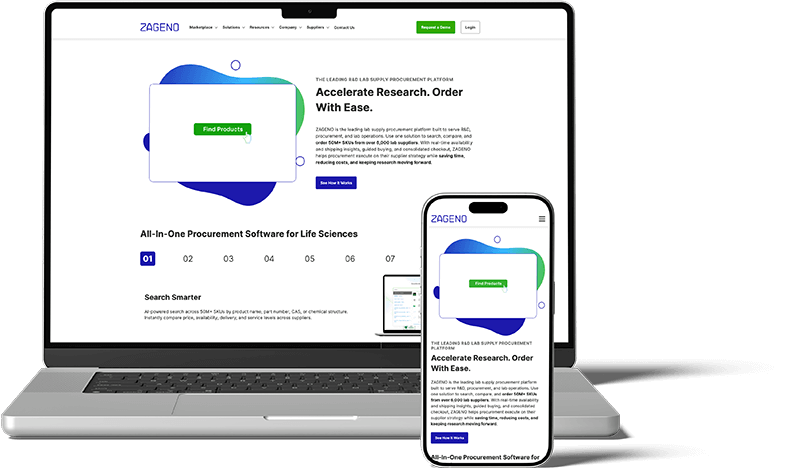
Put supplier consolidation into practice with ZAGENO
Supplier consolidation is not just a strategic goal—it is an operational shift.
ZAGENO enables life sciences organizations to:
- Consolidate management without reducing supplier choice.
- Unify workflows across finance, procurement, and lab teams.
- Gain full visibility into supplier performance and spend.
- Reduce administrative burden and purchase order complexity.
By acting as a single entry point across thousands of suppliers, ZAGENO allows organizations to simplify procurement while supporting the realities of modern lab environments.
Request a demo to see how ZAGENO supports supplier consolidation in lab procurement.
Related resources