
Last updated: July 2026
Behind every scientific breakthrough is a procurement process that ensures materials arrive on time, meet quality standards, and stay within budget. When procurement works, research moves; when it doesn't, experiments stall.
As pharmaceutical and biotech R&D grows more complex, modern life sciences procurement has evolved far beyond mere transactional purchasing. Today, it connects researchers, suppliers, enterprise systems, and scientific data to streamline laboratory operations and accelerate research.
What is life sciences procurement?
Life sciences procurement is the practice of scientific procurement within pharmaceutical and biotech organizations. Its goal is simple: give researchers what they need, when they need it, while balancing speed, compliance, cost, and scientific quality
To understand where the industry is heading, explore how Scientific Procurement Orchestration builds on these principles by connecting researchers, suppliers, enterprise systems, and AI into a single workflow. To further understand how platforms support this process, see lab procurement software.
The R&D distinction: tactical purchasing vs. strategic procurement
Every research organization purchases supplies, but high-performing organizations manage procurement strategically. The difference becomes vital as research complexity, supplier networks, and compliance requirements grow.
- Purchasing is transactional: It focuses on the immediate task of placing orders and meeting short-term research needs
- Procurement is strategic: It holistically manages suppliers, sourcing, compliance, pricing, and long-term research support.
Comparison: Purchasing vs. procurement
| Purchasing | Procurement |
|---|---|
| Places orders | Builds supplier strategy |
| Supports immediate needs | Supports long-term research |
| Focuses on individual transactions | Coordinates suppliers, compliance, and cost |
| Measures price | Balances price, quality, availability, and governance |
Modern scientific procurement extends far beyond purchasing. It connects supplier strategy, scientific workflows, and operational processes to help researchers spend less time navigating procurement and more time advancing science. This balance is increasingly orchestrated behind the scenes by modern Research Operations teams, who connect protocol demands with corporate purchasing structures.
Understanding this difference also helps organizations accurately categorize laboratory spend and apply the right procurement strategy. For a closer look at managing these specific accounting categories, see our guide on Direct vs. Indirect Lab Procurement.
Managing this complexity requires more than standard purchasing software. It requires connected supplier data, intelligent workflows, and complete visibility across the entire research ecosystem.
Why life sciences procurement is uniquely complex
Scientific procurement operates in an environment where research priorities shift quickly, supplier networks are global, and compliance is non-negotiable. The result is a level of complexity that traditional, generic procurement systems were never designed to manage.
- R&D unpredictability: Research protocols evolve quickly, and procurement systems must adapt without slowing experimentation.
- Regulatory oversight: Pharma and biotech organizations operate under GxP and audit requirements. The U.S. Food and Drug Administration outlines current Good Manufacturing Practice (cGMP) standards that make documentation and traceability mandatory.
- SKU fragmentation: Labs often source from thousands of global and niche suppliers. Without centralized sourcing, fragmented supplier ecosystems create pricing inconsistencies and onboarding risk. As environments scale, it reduces visibility across purchasing workflows, supplier relationships, and operational coordination.
- Scientific substitution risk: Substituting a reagent or assay kit can compromise research reproducibility, reinforcing the importance of precise, vetted sourcing workflows.
These challenges become even more pronounced in pharmaceutical organizations, where procurement must scale across global supplier networks while maintaining strict regulatory compliance. See how this plays out in our deep dive into pharma procurement strategy.
AI readiness: Turning sourcing data into AI ROI
Many R&D organizations invest in AI only to find that algorithms cannot deliver ROI on dirty, fragmented data. True AI readiness starts with operational infrastructure. Organizing laboratory purchasing through a single-entry point creates the structured data AI needs to automate and improve procurement over time.
Connected data and workflows also provide the foundation for agentic AI in pharmaceutical procurement, which can coordinate approved actions across purchasing systems while escalating scientific, compliance, and commercial decisions to people.
- Predictive sourcing: Forecasting exactly when reagents will run out to trigger automated reordering before experiments stall.
- Supply chain resilience: Analyzing shipping data in real-time to predict bottlenecks and dynamically route orders to alternative vendors.
- Spend optimization: Instantly auditing millions of "longtail" transactions to identify bulk discounts and cost-saving opportunities.
The evolution of scientific procurement in pharma and biotech
As research organizations grow, scientific procurement typically evolves through four distinct stages, with each stage improving visibility, control, and research alignment:
See how integration plays a role in this transition in our guide to procurement integration for biotech.
Choosing your structure: centralized vs. decentralized procurement
Choosing the right procurement structure becomes increasingly important as organizations grow. Centralized procurement offers greater visibility and control, while decentralized models provide flexibility but introduce complexity at scale.
| Feature | Decentralized (Lab-Led) | Centralized (Platform-Led) |
|---|---|---|
| Purchasing Power | Low (Individual orders) | ✅ High (Volume-based savings) |
| Compliance | Variable (Hard to track) | ✅ Uniform (Audit-ready) |
| Scientist Admin | High (Ordering takes 2-4 hrs/wk) | ✅ Low (Ordering takes < 15 min) |
| Visibility | Siloed (Spreadsheet-based) | ✅ Total (Real-time analytics) |
Strategic benefits of modernizing lab procurement
Modernizing procurement provides measurable impacts that move beyond simple cost savings. By transitioning from reactive purchasing to a structured, centralized strategy, labs gain the agility needed to support rapid scientific scaling.
-
- Accelerated research timelines. A primary benefit is ensuring reagents are on the bench before experiments begin, eliminating the lab supply scavenger hunt lag. According to McKinsey & Company, resilience in life sciences requires real-time visibility to prevent clinical delays. Centralization ensures materials are available when experiments begin and improves lab purchasing workflow efficiency.
- Standardized GxP compliance and risk mitigation. Life sciences organizations must meet strict regulatory requirements for hazardous materials and traceability. A centralized strategy ensures every purchase meets quality standards by default.
- Optimized cost control and savings. Centralizing procurement helps bring maverick spend under control by making approved suppliers and workflows easier to use. It also gives labs greater leverage to negotiate volume-based discounts and rebates.
- Reduced administrative friction. Decentralized purchasing leads to manual errors and approval bottlenecks. By implementing standardized workflows, labs reduce the "hidden" cost of procurement: the hours scientists spend tracking orders.
- Strategic supplier partnerships. Consolidating purchasing allows labs to transition from being a transactional customer to a strategic partner. This scale unlocks priority support and better service-level agreements (SLAs). Learn how to approach this effectively with our guide to supplier consolidation for lab procurement.
Measurable impact: The ROI of centralization
Organizations that modernize their life sciences procurement framework report significant operational improvements:
| 6.5 Hours Saved | 70% Reduction |
|---|---|
| Per week, per scientist on sourcing and ordering tasks. | In time spent on manual 3-way matching and invoice reconciliation. |
| 2–4 Weeks Faster | 20% Time Reclaimed |
| Supplier onboarding and integration into the lab ecosystem. | Of total scientist time diverted from admin back to core research. |
📊 Want to see the data behind these numbers? Explore our case study library
To translate these outcomes into a working scorecard, see the procurement KPIs that matter in pharmaceutical R&D.
Many organizations are improving operational performance by adopting structured pharma procurement best practices focused on visibility, workflow standardization, and supplier coordination.
Key components of a modern life sciences procurement strategy
To move from reactive purchasing to a scalable procurement strategy, organizations should focus on four core capabilities.
- Guided buying and preferred sourcing: A modern strategy utilizes guided buying to automatically guide researchers toward preferred contracts, pre-negotiated pricing, and approved vendors at the exact point of search. This eliminates rogue spending without creating administrative roadblocks for scientists.
- Real-time spend visibility. Modern strategies replace disconnected spreadsheets with real-time reporting. This allows Finance and Lab Ops to track spending by project, cost center, or GL code, ensuring that lab spend management in R&D remains accurate as the organization scales.
- Configurable compliance controls. In regulated GxP environments, "one-size-fits-all" approvals do not work. A modern framework utilizes automated audit trails and configurable routing based on research budgets, making compliance a "built-in" feature rather than an administrative hurdle.
- Seamless ERP and Procure-to-Pay (P2P) integration. Procurement becomes truly strategic when it connects to your financial core. By integrating with ERPs such as NetSuite and SAP, you automate the end-to-end P2P workflow, from initial requisition to final 3-way matching and payment. Learn more about platform-level capabilities with lab ERP and P2P integrations.
Back to Top
Where ERP systems fall short: ERP vs. pharmaceutical procurement software
While ERP systems provide essential financial control, they are rarely built to manage scientific catalog complexity or the uniqueness of R&D sourcing.
| Capability | ERP Alone | Pharmaceutical Procurement Software |
|---|---|---|
| Financial Posting | ✅Y es | ✅ Yes |
| Multi-supplier Aggregation | ➖ Limited | ✅ Yes |
| Scientific Catalog Comparison | ❌ No | ✅ Yes |
| Real-time Availability | ➖ Limited | ✅ Yes |
| Lab-specific Approval Routing | ➖ Basic | ✅ Configurable |
ERP systems provide essential financial control, but pharmaceutical procurement software is built to address the specialized needs of R&D, including complex scientific catalogs, supplier access, product data, approval workflows, and research-specific purchasing. Purpose-built life sciences procurement platforms complement the ERP by connecting these capabilities with the financial systems organizations already use.
Driving procurement transformation: Overcoming common pitfalls
Even the most well-funded labs can fall into the "Innovation Gap," where outdated procurement habits slow down AI-accelerated scientific breakthroughs. Moving toward a modernized strategy requires identifying and fixing these common operational bottlenecks.
When procurement doesn't keep pace
Outdated habits aren't just annoying; they are expensive. When lab digitalization is "skin-deep," organizations face measurable friction that slows down the bench:
| The Digitalization Gap | The Real Operational Impact |
|---|---|
| Manual Data Entry | 20% of scientist time diverted from research to administrative tasks. |
| Decentralized Ordering | 15–20% higher costs due to lost bulk-buy and contract opportunities. |
| Poor Lead-Time Visibility | 2–4 week delays in project milestones due to preventable stockouts. |
| Paper-Based Approvals | 48-hour average delay in order processing times. |
Improve inventory and planning with tips for better lab inventory management.
The tactical fix-it guide for common lab procurement mistakes
| Mistake | Quick Fix | Pro Tip |
|---|---|---|
| 🔒 Limited supplier base | Diversify your vendor base using a lab supply marketplace | Choose a platform that offers side-by-side comparisons and availability checks |
| 📦 Poor inventory tracking | Implement automated inventory management tools | Connect your inventory to your procurement system for seamless reordering |
| 💸 Focusing on price only | Evaluate total cost of ownership (TCO), not just unit price | Consider shipping, cold-chain, maintenance, and reliability in your calculations |
| 🔄 Lack of formal workflows | Standardize processes with approval workflows and preferred vendor lists | Use procurement platforms that allow customized workflows by department |
| 🔍 Skimping on comparisons | Thoroughly compare specifications, pricing, and vendor reliability before buying | Leverage multi-vendor platforms to simplify comparisons |
| 🕵️♂️ Inadequate supplier vetting | Verify supplier certifications, customer reviews, and fulfillment history | Prioritize vendors with ISO or GMP certifications for critical supplies |
| ✍️ Manual purchasing | Automate orders and approvals with digital procurement tools | Integrate purchasing into your lab operations platform for greater efficiency |
| ⏳ Delaying reorders | Set minimum stock thresholds and enable low-inventory alerts | Forecast supply needs based on project timelines to avoid emergencies |
| 🙈 No procurement ownership | Assign clear procurement roles and responsibilities | Make procurement tasks part of onboarding and project planning |
| 📊 Ignoring procurement data | Track and analyze spend patterns, supplier performance, and delivery times | Use procurement dashboards to find hidden savings and avoid bottlenecks |
8 strategic pitfalls to avoid during transformation
To truly elevate procurement from a back-office function to a strategic partner, R&D leaders must navigate these broader organizational traps:
- The “one-size-fits-all” trap. What works for a global pharmaceutical giant rarely fits a lean biotech startup. Early-stage biotechs must prioritize flexibility over rigid, long-term contracts.
✅ The Fix: Tailor your strategy to your growth stage. Specialized biotech procurement solutions allow you to scale workflows as your pipeline matures. - Accepting “the way it’s always been done.” Many labs believe that bogged-down processes and "sticky-note" ordering are unavoidable. When scientists spend 20% of their week chasing orders, productivity suffers.
✅ The Fix: Implement automation for repetitive tasks. Digital marketplaces are designed to streamline lab procurement and return time to the bench. - Underutilizing procurement data. Data is the heart of modern sourcing, yet most teams lack the tools to turn invoices into insights. Without visibility into supplier performance or spend trends, you cannot optimize your budget.
✅ The Fix: Use real-time analytics to identify cost-saving opportunities and manage longtail spend. - Stagnant supplier loyalty. Relying on a narrow group of “legacy” vendors might feel safe, but it often prevents access to cutting-edge technologies.
✅ The Fix: Use a multi-vendor platform to discover global innovation without administrative complexity. Diversification is the key to supply chain resilience. - Hidden losses in longtail spend. Low-value, high-volume purchases quietly drain budgets. When unmanaged, they lead to pricing inconsistencies and massive processing costs.
✅ The Fix: Consolidate longtail purchasing through a unified marketplace to capture immediate savings, much like Sanofi optimized their spend. - Vulnerable supply chains. A lack of contingency planning can leave your lab scrambling during a global shortage. An unreliable supply chain halts critical experiments.
✅ The Fix: Build redundancy into your strategy by using platforms that provide real-time transparency into global stock levels. - Falling for “greenwashing.” Sustainability is a priority, but vague claims make it hard to measure impact.
✅ The Fix: Prioritize verified sustainability metrics. Work with platforms that vet suppliers against rigorous environmental standards to ensure green procurement goals are met. - Treating procurement as a back-office function. Procurement is often undervalued, but it is actually a primary driver of R&D speed.
✅ The Fix: Reposition procurement as a strategic partner. When integrated into lab ops, it fuels breakthroughs rather than just processing transactions.
Avoiding these pitfalls isn't just about changing policy, it's about having the right infrastructure to support your scientists. See how ZAGENO’s platform is purpose-built to eliminate these bottlenecks and automate your path to procurement maturity.
Overcoming implementation hurdles
Even digitally enabled labs run into common implementation challenges. Successful transformation requires addressing these four friction points:
| Pitfall | What Happens | How to Address It |
|---|---|---|
| Fragmented systems | Teams toggle between vendor sites, emails, and spreadsheets. | Centralize supplier access and approvals via a biotech procurement solution. |
| Manual paperwork | Missed approvals and reconciliation delays. | Automate workflows end-to-end to eliminate touch points |
| Low user adoption | Tools go unused or bypassed by scientists. | Invest in platforms designed with lab-first usability in mind. |
| Compliance blind spots | Purchases fall outside audit trails | Ensure all orders flow through a single system. |
The next evolution of life sciences procurement
Achieving procurement maturity is about embracing a connected procurement ecosystem that scales with your science. A modernized approach replaces fragmented workflows with a single, intelligent interface.
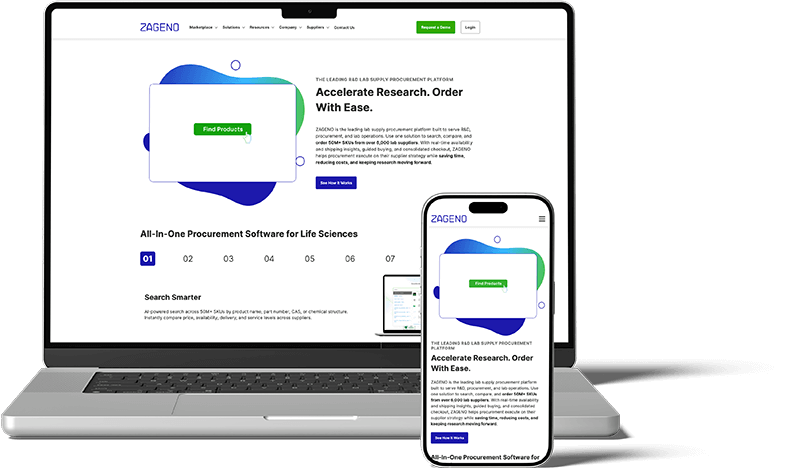
ZAGENO helps pharmaceutical and biotech organizations move beyond fragmented procurement by combining a connected scientific marketplace, intelligent workflows, and enterprise integrations into one platform.
- Connected scientific marketplace: Act as a single-entry point to access 50 million+ products from thousands of global suppliers in one place, ending the administrative burden of jumping between vendor sites and logging into multiple legacy portals. The marketplace also creates a standardized supplier and product data foundation that supports automation, analytics, and enterprise AI.
- Guided buying and demand steering: Automatically direct search traffic and purchase requests toward pre-approved contracts, preferred vendors, and validated budgets without frustrating your scientific team.
- Smart approval routing: Replace paper-based delays with configurable digital workflows that align with your specific R&D budgets and GxP requirements.
- The single creditor model: One vendor, one invoice, thousands of suppliers, dramatically reducing the burden on your finance team.
- Real-time spend analytics: Gain instant visibility into your longtail spend and supplier performance, turning raw data into actionable cost-saving insights.
- Enterprise-grade integrations: Seamlessly connect your lab's sourcing directly to your ERP (NetSuite, SAP, Coupa) for automated 3-way matching and touchless financial posting.
- White-glove support: Scientific customer success teams who speak the language of the lab.
Modern research deserves modern procurement
Researchers shouldn't have to wait for procurement. See how leading pharmaceutical and biotech organizations are simplifying purchasing, strengthening governance, and returning more time to science.
FAQs about life sciences procurement
- What is life sciences procurement?
Life sciences procurement is the strategic sourcing and management of the materials, equipment, suppliers, and services that support pharmaceutical and biotech research. Its goal is to ensure researchers have what they need while balancing compliance, cost, quality, and speed
-
How is life sciences procurement different from traditional procurement?
Traditional procurement focuses on purchasing goods and controlling costs across a generic corporate organization. Life sciences procurement must uniquely support scientific research, specialized global suppliers, strict regulatory requirements (GxP/cGMP), and research continuity. -
Why do scientists bypass procurement systems?
Researchers often work under tight deadlines and need fast access to highly specialized products. Modern procurement platforms improve adoption by simplifying purchasing while automatically applying organizational policies and preferred supplier strategies in the background. -
Does a life sciences procurement platform replace an ERP?
No. ERP systems remain the financial system of record. A life sciences procurement platform complements the ERP by managing complex scientific catalogs, supplier networks, custom approvals, and research-specific workflows. -
What is Scientific Procurement Orchestration?
Scientific Procurement Orchestration is the next evolution of life sciences procurement. It connects researchers, suppliers, enterprise systems, AI, and procurement workflows into one coordinated operating model that helps research organizations improve visibility, governance, and research productivity.
Related resources