

As life sciences organizations adopt more digital tools, lab tech stacks are becoming increasingly complex. Teams often juggle a combination of systems—LIMS, ELNs, procurement platforms, and ERP tools—each designed to solve a different part of the workflow.
A common point of confusion is how these systems relate to one another. While lab management systems are essential for organizing experiments and data, they are not designed to manage supplier sourcing or purchasing at scale. This guide clarifies the differences between lab management systems and lab procurement platforms, and how modern labs use them together to operate efficiently.
For a full breakdown of lab management systems and tools, see our guide to lab management tools, software, and systems.
Why labs confuse procurement platforms and lab management systems
It’s easy to see why these systems get mixed up. Most labs only notice them if something goes wrong, like an unavailable reagent, unclear spend, or mismatched invoices. In those moments, it’s natural to wish for a single system that solves everything.
This confusion is often reinforced by overlapping vendor language. Terms like “lab operations” or “inventory” are used across the board, even when the tools serve entirely different functions. The simplest way to distinguish them is to look at their primary purpose.
Lab management systems vs procurement platforms
Lab management systems and procurement platforms serve different but complementary functions:
| Function | Lab Management Systems (LIMS / ELN) | Procurement Platforms |
|---|---|---|
| Primary focus | Experiments, workflows, data | Supplier sourcing, purchasing, spend |
| Users | Scientists, lab managers | Procurement, finance, operations |
| Scope | Internal lab operations | External vendor management |
| Key value | Data integrity, reproducibility | Efficiency, cost control, visibility |
The key distinction: systems of record vs systems of execution
The difference between lab management systems and procurement platforms can be understood in simple terms:
- Lab management systems are systems of record. They store and manage scientific data, experiments, and workflows inside the lab.
- Procurement platforms are systems of execution. They manage how supplies are sourced, approved, purchased, and tracked across suppliers, supporting the work of Research Operations teams that keep scientists focused on research.
This distinction explains why the two systems are complementary rather than interchangeable. One manages what happens in the lab, while the other manages how the lab is supplied and funded.
Why one system can’t replace the other
Lab management systems don’t solve procurement because they aren't built for market complexity. They typically cannot compare products across multiple suppliers, manage real-time lead times, or replace supplier-specific purchasing portals with a centralized procurement experience.
Conversely, procurement platforms don’t replace lab management because they stay separate from the scientific workflow. They do not capture experimental data or track specific protocols. This separation is intentional; it maintains data integrity and ensures clear ownership between the scientific and finance teams.
How modern labs scale
Modern labs rely on a "best-of-breed" technology stack where each system has a defined role:
- Scientists work in LIMS and ELNs to run experiments and document results
- Procurement platforms manage sourcing, purchasing, and approvals
- ERP systems handle accounting, reconciliation, and reporting
This modular approach allows labs to scale without overloading a single system or creating operational bottlenecks.
Where punchout catalogs fit
Punchout catalogs often create confusion but are not standalone systems. A punchout catalog is a connection method that links a supplier’s catalog to an ERP or procurement system.
Punchout enables:
- Real-time pricing and availability
- Seamless ordering workflows
- Reduced manual entry
However, punchout does not:
- Manage sourcing across suppliers
- Consolidate purchasing workflows
- Provide full spend visibility
For that reason, punchout is best understood as a component within a broader procurement strategy.
For more information, see our lab punchout catalogs guide.
Common misconceptions labs have
Where ZAGENO fits into the modern lab
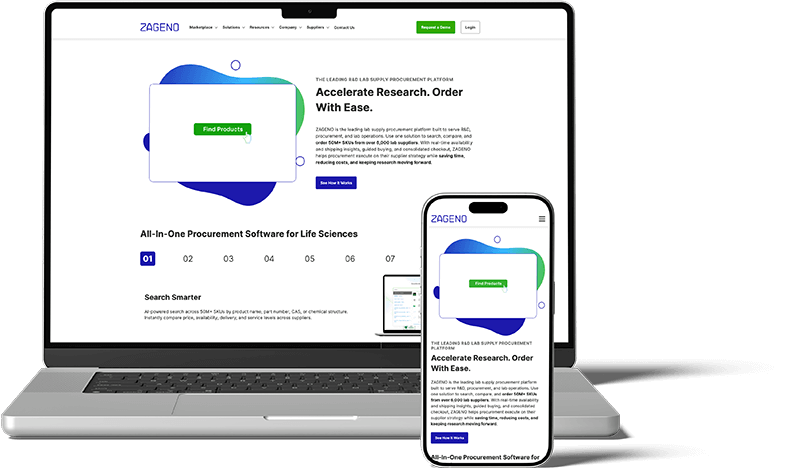
ZAGENO is a lab procurement platform designed specifically for strategic life sciences procurement. It is not a LIMS or ELN; rather, it acts as the operational layer that connects your lab to thousands of suppliers.
By integrating with your existing ERP and lab management tools, ZAGENO allows teams to access and compare millions of products and consolidate purchasing into a single, compliant workflow—all without disrupting the scientific "system of record."
See how procurement fits into your lab workflow
Understanding the difference between lab management systems and procurement platforms is the first step. The next step is seeing how these systems work together in practice.
Explore how ZAGENO supports lab procurement at scale while fitting cleanly alongside LIMS, ELNs, and ERP systems.
FAQs about lab management systems and procurement platforms
- What is a lab management system?
A lab management system is software used to manage laboratory workflows, including sample tracking, data management, and compliance. Common types include LIMS (Laboratory Information Management Systems) and ELNs (Electronic Lab Notebooks), which help ensure experiments are organized, reproducible, and auditable. - What is the difference between a lab management system and a procurement platform?
A lab management system manages scientific workflows and data inside the lab. A procurement platform manages supplier sourcing, purchasing, approvals, and spend across vendors. The two systems serve different purposes and are typically used together. - Can a lab management system handle procurement?
Most lab management systems do not support supplier comparison, purchasing workflows, or multi-vendor sourcing. Labs typically use procurement platforms alongside these systems to manage purchasing at scale. - Do biotech labs need both lab management software and procurement software?
Yes. Lab management software supports research workflows, while procurement software manages suppliers and purchasing. Using both allows labs to scale operations efficiently without overloading a single system. - What is a punchout catalog, and is it a procurement platform?
A punchout catalog is a connection method that links a supplier’s catalog to a procurement or ERP system. It enables real-time ordering and pricing but is not a procurement platform itself. - How do procurement platforms integrate with lab systems?
Procurement platforms integrate with LIMS, ELNs, ERP, and P2P systems to streamline purchasing workflows, improve data visibility, and connect scientific and operational processes.
Related resources