

Lab spend is one of the largest and least controlled cost drivers in biotech and pharma organizations. As research teams scale and supplier networks expand, lab spend becomes fragmented across departments, vendors, and purchasing workflows—making it difficult to track, control, and optimize.
Without clear visibility into lab spend, procurement teams struggle to identify inefficiencies, enforce supplier strategy, and support research at scale. Managing lab spend effectively requires more than tracking purchases, it requires alignment with a broader life sciences procurement strategy.
What is spend management in R&D procurement?
Spend management is the practice of understanding, controlling, and optimizing how capital is allocated for lab supplies, scientific equipment, and services. In complex R&D environments, this includes:
Effective spend management starts with gaining control—ensuring that every purchasing decision is visible, coordinated, and aligned across the organization
The hidden costs of poor lab spend management
Without a structured approach, even high-performing labs experience "budget leakage" through common inefficiencies:
- Duplicate orders placed by different teams unaware of existing inventory.
- Overstocking which leads to expired materials and wasted capital.
- Administrative friction caused by hours spent reconciling disparate invoices and purchase orders.
- Off-contract purchasing, or maverick spend, resulting in inconsistent pricing and reduced visibility.
What causes fragmented lab spend in procurement?
The primary root cause of spend mismanagement is fragmented supplier networks. In growing biotech and pharma organizations, purchasing is often decentralized. When teams order from different suppliers without cross-departmental visibility, it leads to:
- Duplicate suppliers across teams for the same product categories.
- Inconsistent pricing and contract terms for the same items.
- Increased administrative burden on finance and procurement teams.
- Limited visibility into total spend.
These challenges become even more complex in pharmaceutical environments, where procurement must scale across global supplier networks while maintaining strict regulatory compliance. See how this is addressed in pharmaceutical procurement strategy.
One of the most effective ways to address these hurdles is through supplier consolidation for lab procurement, which helps reduce vendor complexity while maintaining the flexibility scientists need to innovate.
Why tail spend is a major driver of inefficiency
Tail spend refers to the high volume of low-value purchases spread across a large number of unmanaged suppliers. In a typical lab, tail spend may only represent a small percentage of total dollars spent, but it often accounts for the vast majority of individual suppliers.
Managing this “tail” effectively requires better visibility into purchasing patterns and a shift toward centralized procurement processes to reduce the number of one-off vendor interactions.
Core components of an effective lab spend management strategy
To regain control, procurement teams should focus on these four pillars:
How biotech procurement platforms improve lab spend management
Modern procurement platforms help organizations manage lab spend by capturing purchasing activity through a single workflow. ZAGENO’s procurement spend analytics provide a current view of spending by supplier, category, department, project, cost center, and site. Procurement can use those insights to identify fragmented purchasing, evaluate supplier adoption, and act on spend patterns without adding work for researchers.
Key metrics to track
To evaluate the success of your strategy, monitor these KPIs:
- Spend per experiment or project.
- Percentage of spend with preferred suppliers.
- Tail-spend ratio (number of suppliers vs. total spend)
These measures are a starting point. A broader R&D procurement KPI framework can also track scientist time, request-to-order speed, supplier adoption, approval exceptions, transaction effort, and order reliability.
Case study: Reducing lab spend complexity at scale
A large pharmaceutical organization struggling with decentralized purchasing across multiple research sites implemented ZAGENO to centralize their procurement.
The results were immediate:
- 50% reduction in ordering time within just two weeks.
- Total visibility into lab spend across all research teams.
- Significant reduction in manual administrative overhead.
Read the full story: How a Large Pharma Cut Down Lab Supply Ordering Time by 50% in 2 Weeks

Getting started: 3 ways to improve lab spend management
- Audit your current spend. Identify gaps in visibility, inconsistent workflows, and unmanaged suppliers
- Focus on high-impact categories. Prioritize areas where fragmentation and tail spend are highest
- Adopt centralized procurement tools. Use platforms that provide visibility, control, and scalability
FAQ: lab spend management in biotech and pharma
-
Why is lab spend difficult to manage in biotech and pharma?
Lab spend is difficult to manage because purchasing is often decentralized across teams, suppliers, and systems. This leads to fragmented supplier networks, inconsistent pricing, and limited visibility into total spend. -
How can organizations reduce lab spend?
Organizations reduce lab spend by improving visibility, standardizing procurement workflows, and consolidating suppliers. Strategies like supplier consolidation help reduce vendor complexity while maintaining access to critical scientific products. -
What tools help manage lab spend?
Biotech procurement platforms with built-in analytics help organizations manage lab spend by centralizing purchasing, tracking supplier usage, and providing real-time visibility into spending patterns.
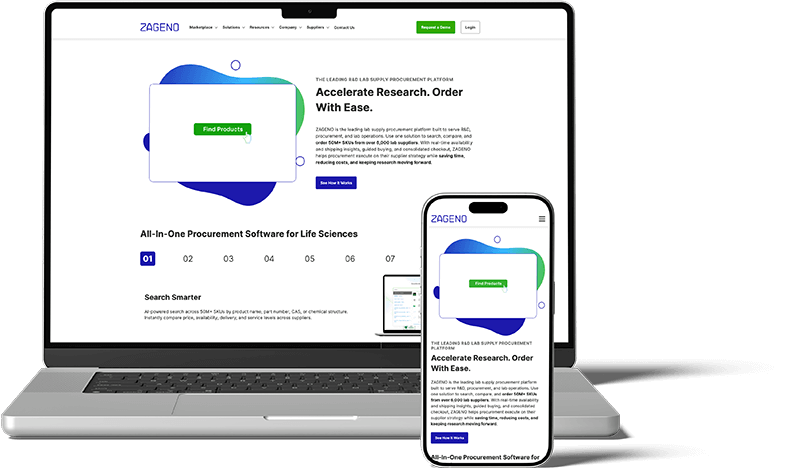
Take control of your lab spend with ZAGENO
Managing lab spend is not just about cutting costs, it’s about enabling better decision-making across procurement, finance, and research teams.
ZAGENO helps you:
- Gain visibility into lab spend across suppliers.
- Eliminate tail spend and supplier fragmentation.
- Standardize workflows without slowing down scientific discovery.
Request a demo to see how ZAGENO manages lab spend at scale.
Related resources