

As biotech teams grow, they often turn to enterprise resource planning (ERP) systems like NetSuite to strengthen financial controls and support investor expectations around visibility and compliance. These systems work well for accounting and budget governance, but they were not designed for scientific purchasing, which changes every day and involves thousands of specialized products across many suppliers.
As research demand increases, procurement workflows inside an ERP start to break. Experiments slow down. Financial accuracy suffers. Lab teams improvise workarounds that create even more operational risk.
This guide explains why ERPs struggle with lab supply procurement, how to recognize the early warning signs, and what fast-growing biotechs do to fix the problem without replacing their ERP.
How do you know your ERP procurement workflow is failing?
These warning signs appear again and again across scaling biotechs:
- Backorders and unexpected supply delays
- Month-end close slipping due to missing data
- Frequent coding or cost center errors
- Scientists ordering through emails or vendor websites
- Shadow spreadsheets used to track orders
- Slow supplier setup that delays experiments
- Finance teams spending hours fixing invoice mismatches
If more than two of these are happening regularly, your team has outgrown ERP-only procurement.
For more insight on spend control, visit our article on spend management for biotech procurement.
Why do ERP procurement issues affect biotechs more than other industries?
For additional context, see McKinsey’s analysis of procurement digitization.
What does a biotech-ready procurement workflow look like?
Biotechs that fix ERP procurement issues do not replace their ERP. Instead, they add a biotech-specific procurement layer, such as ZAGENO, designed for scientific purchasing while the ERP continues to manage financial governance.
A strong biotech purchasing workflow includes:
- Unified product search across all suppliers. Scientists and lab managers should be able to search and compare products from millions of SKUs in one place.
- Fast supplier onboarding. New suppliers should be added in hours, not weeks, to prevent experiment delays.
- Preferred supplier routing. Teams should reinforce contract pricing and achieve rebate thresholds automatically.
- One metacart, one PO, one invoice. Consolidated checkout keeps procurement clean and reduces reconciliation time for finance. This ties directly to our procurement solutions.
- Automated 3-way match. PO, receipt, and invoice alignment should be automatic.
Real-time availability and delivery tracking. Research stays on schedule without constant follow-ups. - Seamless ERP integration. The ERP stays in control of accounting. Procurement becomes faster, clearer, and easier to manage.
A helpful external reference: Deloitte’s 2025 Global CPO Survey on digital transformation.
Resource: How leading biotechs fix ERP procurement bottlenecks
Biotechs that successfully streamline procurement tend to follow similar patterns:
- They keep NetSuite or SAP as their financial backbone
- They layer a scientific procurement platform, such as ZAGENO, on top
- They consolidate orders into one cart
- They route spend to preferred suppliers
- They shorten the time-to-onboarding for new vendors
- They automate PO and invoice workflows
- They improve spend visibility and protect the runway
- They reduce experiment delays
This structure gives labs speed while giving finance the accuracy and governance they need.
When should a biotech add a procurement layer to its ERP?
Most teams make the move when they experience:
- 15 to 20 or more lab supply orders per week
- Experiments held up by delayed vendor onboarding
- Inconsistent purchasing data during month-end
- Frequent backorders or last-minute supplier changes
- More orders happening outside the ERP
- Repeated reconciliation issues
- Heavy reliance on spreadsheets to track supply status
These are the clearest signs that ERP-only procurement is no longer working.
Key takeaway: ERPs are essential, but they cannot power scientific procurement alone
ERPs provide structure, financial control, and compliance, but they cannot address the speed, diversity, and variability of scientific purchasing. As biotechs scale, procurement bottlenecks become more visible and more expensive.
The most effective approach is to keep the ERP as the accounting backbone and add a procurement layer designed specifically for lab supply workflows. This improves visibility, reduces errors, accelerates research, and strengthens financial controls.
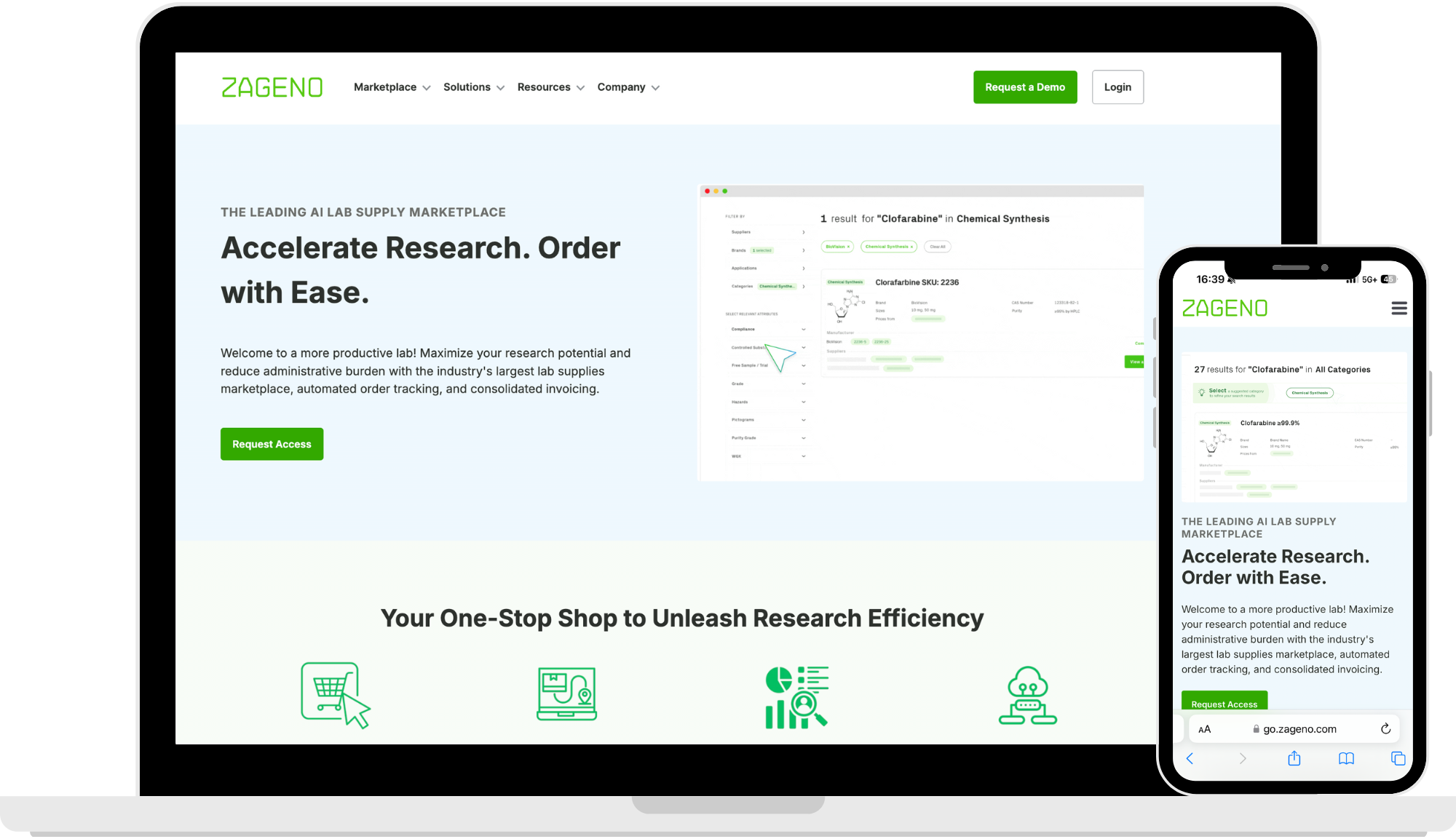
Talk to our team about connecting your ERP with a procurement layer built for biotech.
See how ZAGENO supports R&D, procurement, and finance with one integrated solution.
Related resources