
Pharmaceutical R&D procurement generates data across products, suppliers, prices, contracts, orders, approvals, inventory systems, and research sites. When that information is accurate and connected, teams can compare purchases, enforce policies, analyze spend, and make better decisions. When data is fragmented or inconsistent, even advanced procurement technology has little reliable information to work with.
Procurement data management provides the foundation for more connected purchasing and trustworthy AI. For pharmaceutical and biotech organizations, the challenge is not simply collecting more data. It is creating consistent, usable information from highly specialized products and constantly changing supplier networks.
Why procurement data is especially complex in pharmaceutical R&D
Scientific procurement does not follow the predictable buying patterns found in many other industries. Research requirements shift as experiments evolve, and scientists frequently need highly specialized materials that have never been purchased before.
The same type of item may appear under different supplier descriptions, catalog numbers, units of measure, or packaging configurations. For example, a reagent sold as a single bottle, a multipack, or in several concentrations cannot be compared accurately by name alone.
This complexity grows as organizations add research sites, local suppliers, negotiated pricing arrangements, and disconnected systems. Repeat purchasing creates another hurdle. As scientific programs evolve, historical records may not provide an obvious path to the next purchase.
These conditions make accurate data management a core part of an effective life sciences procurement strategy, not simply an administrative cleanup project.
Procurement teams need several connected types of data to understand what is being requested, where it can be purchased, whether it meets organizational requirements, and how the transaction should proceed.
What procurement data should pharmaceutical R&D teams manage?
Procurement master data vs. transactional data
Procurement master data describes the relatively stable entities used across purchasing processes. Transactional data records the individual activities involving those entities.
| Procurement master data | Transactional procurement data |
|---|---|
| Products and scientific items | Requisitions |
| Suppliers and manufacturers | Quotes |
| Categories and units of measure | Purchase orders |
| Contract and payment terms | Approvals and receipts |
| Cost centers and approval rules | Invoices, returns, and cancellations |
Both are essential. Clean supplier records have limited value if orders are logged inconsistently. Accurate transaction histories are also less useful when items cannot be matched across systems.
What happens when procurement data is unreliable?
Poor data quality creates friction throughout the purchasing cycle. Inconsistent names and identifiers can make one supplier or product appear as several, obscuring total spend and weakening sourcing decisions. Mismatched quantities, concentrations, pack sizes, or units of measure make accurate product comparisons difficult.
Disconnected pricing can prevent negotiated terms from being applied when purchasing decisions are made. Missing cost centers or supplier records force procurement and finance teams into manual exception handling. Inconsistent classifications can also produce reports that show how much was spent without clearly explaining what was purchased.
These problems compound when AI is introduced. Incomplete attributes, duplicate records, and inconsistent histories can result in irrelevant product matches, misleading forecasts, or recommendations that conflict with procurement policies.
How procurement data management supports AI readiness
AI readiness begins long before a model or purchasing assistant is deployed. It relies on accurate, relevant, and well-governed data. The same data foundation enables agentic AI in procurement to coordinate approved actions across connected purchasing workflows.
The NIST AI Risk Management Framework identifies validity and reliability as important characteristics of trustworthy AI systems. In procurement, dependable underlying data helps support both.
With reliable product attributes and supplier information, AI can interpret natural-language requests, match products across inconsistent supplier catalogs, and identify suitable alternatives more quickly. When pricing, availability, purchasing history, and organizational policies are connected, AI can also recognize preferred suppliers, predict delivery risks, flag unusual activity, and offer recommendations within established guardrails.
As explained in our guide to AI in lab procurement, data management provides the structured context these capabilities require.
How connected systems improve data quality
Pharmaceutical procurement data is typically scattered across ERPs, P2P platforms, inventory systems, ELNs, LIMS, supplier portals, and local spreadsheets. No single system holds everything.
Effective ERP and P2P integrations allow information to move between these environments with less manual re-entry. A clear integration model should also establish which system owns each type of information.
An ERP may serve as the primary source for financial and payment records, while a P2P platform manages requisitions and approvals. Inventory platforms track quantities, locations, and expiration dates. ELNs and LIMS provide scientific workflow context, and suppliers provide catalog, availability, and fulfillment data.
A scientific procurement platform, such as ZAGENO, can harmonize product and supplier information across these environments. The goal is not to force every record into a single database. It is to create clear ownership, consistent definitions, and dependable connections between systems.
This is a core function of scientific procurement orchestration: connecting researchers, suppliers, policies, data, and enterprise systems in one coordinated workflow.
Seven procurement data management best practices for R&D
Better data creates better procurement decisions
Next-level procurement strategy starts with data teams can trust. When product, supplier, purchasing, and workflow information is consistent and connected, pharmaceutical R&D teams gain clearer spend visibility, smoother integrations, and more reliable AI without asking scientists to navigate the complexity behind every purchase.
Frequently asked questions about procurement data management
- What is procurement data management?
Procurement data management is the process of collecting, standardizing, maintaining, governing, and connecting product, supplier, pricing, purchasing, and workflow data. Its purpose is to make procurement information accurate, consistent, accessible, and useful across systems and teams. - What is procurement master data?
Procurement master data describes core reference entities used repeatedly in purchasing processes, such as products, suppliers, categories, cost centers, units of measure, payment terms, and approval rules. It differs from transactional data, which records individual requisitions, purchase orders, receipts, and invoices. - Why is procurement data management important in pharmaceutical R&D?
Pharmaceutical R&D organizations purchase highly specialized materials from complex supplier networks. Accurate procurement data helps teams compare products, apply contract terms, manage approvals, understand spend, evaluate delivery risk, and connect purchasing with scientific workflows. - How does procurement data quality affect AI?
AI uses product attributes, supplier information, purchasing history, pricing, availability, and organizational policies to produce recommendations. Missing, duplicated, or inconsistent data can reduce the relevance and reliability of those recommendations. - Who should own procurement data?
Ownership is usually shared across procurement, finance, IT, Research Operations, lab operations, and data-governance teams. Each data domain should have a designated owner responsible for its definitions, standards, access, quality, and maintenance.
Build a more connected procurement foundation
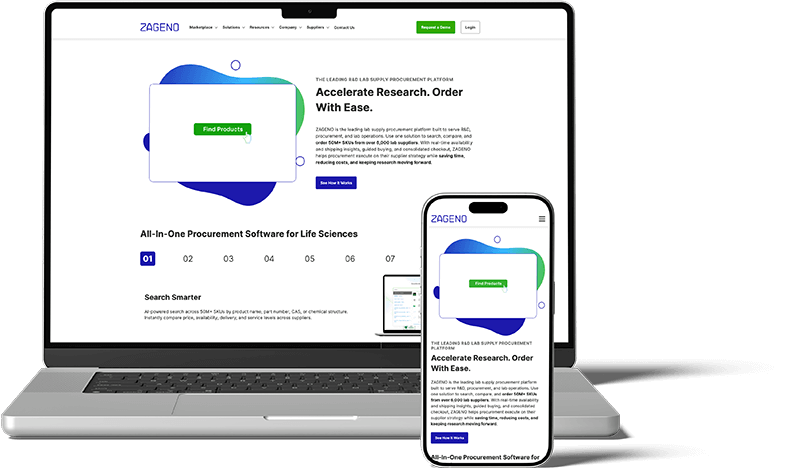
ZAGENO connects scientific purchasing data across products, suppliers, workflows, and enterprise systems, helping pharmaceutical and biotech teams make faster, more informed procurement decisions.
Related resources