
Updated June 2026
Artificial intelligence is changing how scientists buy research supplies.
Until recently, finding the right product meant manually searching catalogs, comparing specifications, checking availability, and evaluating alternatives. AI streamlines this process, making it faster and easier to discover products, compare options, and make informed purchasing decisions.
The result isn't just faster purchasing; it simplifies product sourcing so researchers can spend less time on coordination and more time on science.
Whether through conversational purchasing assistants, chemical structure lookups, or guided buying, AI is redefining the entire laboratory sourcing lifecycle.
What is AI in lab procurement?
It uncovers relevant products, identifies viable alternatives, compares options across hundreds or thousands of suppliers, and surfaces data that would otherwise require significant manual effort
As these capabilities evolve, purchasing is shifting from a tedious manual search to an automated product sourcing process.
How AI changes the way researchers locate products
One of the biggest bottlenecks in scientific purchasing is initial product identification. Researchers may know the exact experiment they want to run without knowing the specific product or supplier they need. Even when they have a specific item in mind, comparing technical specs, real-time availability, and pricing across different suppliers takes time.
Because finding the right product is the first step in the purchasing process, even small improvements in this stage have an outsized impact over hundreds or thousands of annual orders.
AI simplifies this process by:
- Surfacing relevant products based on natural language descriptions or specific research needs
- Recommending in-stock alternatives when preferred items are unavailable
- Automatically identifying similar products across different suppliers
- Improving search relevance and filtering accuracy
- Helping users compare technical options more efficiently
Rather than replacing scientific judgment, AI helps researchers navigate a growing universe of products and suppliers.
The rise of conversational purchasing
Many professionals now use AI assistants to answer questions, summarize complex data, and explore ideas. Scientific purchasing is following a similar path.
Instead of relying strictly on exact product numbers, fragmented supplier catalogs, supplier-specific purchasing portals, and rigid search parameters, researchers can describe what they need in plain language. For example, a scientist can easily search for:
- Antibodies for a specific protein target
- PCR reagents optimized for a particular workflow
- Cell culture supplies that meet defined regulatory requirements
- Chemicals based on molecular structure or direct application
Modern, AI-powered procurement tools interpret these descriptive requests, identify relevant products, locate equivalents, and guide users toward the best purchasing options
This approach, known as conversational commerce, is becoming increasingly common across industries. Market forecasts from Gartner highlight this shift, projecting that up to 40% of enterprise applications will feature embedded conversational AI agents by the close of 2026, up from less than 5% in 2025. This integration is fundamentally changing the digital purchasing experience.
How AI is becoming a research assistant for purchasing decisions
Finding a product is only part of the challenge. Researchers must also evaluate competing options, understand technical tradeoffs, and determine if an alternative will meet their precise testing requirements
AI assists by automatically organizing information and providing contextual insights that support decision-making, such as:
- Comparing granular product specifications side-by-side
- Highlighting lead times and availability differences
- Identifying commonly purchased alternatives within the organization
- Presenting vetted supplier performance and contract data
- Surfacing historical lab purchasing patterns
The goal is not to make decisions for researchers, but to provide them with the comprehensive data they need to buy with confidence.
Making guided buying easier to use
Most research organizations have established preferred supplier programs, negotiated contracts, and internal purchasing policies. The challenge is helping researchers navigate these compliance requirements without slowing down their work.
AI can make guided buying more intuitive. Rather than requiring users to memorize approved suppliers or navigate complex purchasing rules, AI can present preferred options automatically, recommend approved alternatives, and explain why specific products are being recommended. This creates a better user experience for scientists while helping the organization maintain purchasing consistency.
For more, read our guide to pharma procurement best practices, which explores how leading organizations successfully balance researcher needs with broader procurement objectives.
How AI supports pharmaceutical and biotech purchasing
Sourcing scientific supplies is a delicate balancing act. Researchers require products that meet strict technical criteria, purchasing teams require workflow consistency, and leadership needs confidence that spend aligns with business goals.
AI connects these priorities by making product data accessible and choices simpler to navigate while helping Research Operations teams streamline laboratory workflows. Examples include:
Organizations managing extensive supplier networks often face obstacles related to vendor performance, order tracking, and supplier coordination. Our article on supplier ecosystems in pharma procurement explores how leading teams build more resilient and efficient supplier strategies.
As interest in smart purchasing tools grows, organizations are leveraging AI to connect supplier management, purchasing decisions, and daily lab operations. Many of the broader framework strategies behind these efforts are discussed in our core guide to pharma procurement.
AI-powered purchasing in practice
While many discussions about AI focus on future possibilities, several advances are actively being used today:
Rather than replacing scientific expertise, these tools help researchers evaluate options, navigate complex catalogs, and find products more efficiently.
Organizations focused on improving purchasing consistency must also understand the common operational obstacles that emerge as research teams scale. Our article on pharma procurement challenges explores several of the most common issues and practical ways to address them. Additionally, for organizations operating in highly regulated environments, maintaining a clear handle on pharma procurement compliance remains a fundamental pillar of building effective purchasing workflows.
Getting started with AI in lab procurement
Organizations typically see the fastest return on investment when they target a specific workflow challenge. Common starting areas include:
- Product identification and sourcing
- Supplier evaluation
- Purchasing workflows
- Inventory planning
- Spend analysis
Successful long-term adoption depends on three key factors:
Frequently asked questions about AI in lab procurement
- What is conversational purchasing in lab procurement?
Conversational purchasing allows researchers to search for complex scientific products using natural language instead of rigid SKU numbers. Powered by AI, the system interprets intent—such as finding an in-stock equivalent buffer—and instantly returns contract-compliant product recommendations. - How does AI improve scientific product discovery?
AI uses deep semantic mapping and chemical structure search to bypass the limitations of traditional keyword matching. This allows scientists to discover exact matches, stereoisomers, or chemically viable analogs simply by drawing a molecular layout or typing a general workflow description. - Can AI-guided buying help enforce laboratory procurement compliance?
Yes. AI-guided buying automatically embeds negotiated contracts, preferred vendor lists, and spending limits into the researcher's search experience. The platform prioritizes tier-one suppliers and approved alternatives during discovery, seamlessly reducing maverick spend without slowing down active scientific research. - How does AI handle supply chain backorders and product alternatives?
When a critical reagent goes on backorder, AI cross-references global supplier networks to identify functionally equivalent substitutes. It instantly evaluates concentration, purity, and volume against internal contract pricing and real-time shipping windows to ensure lab workflow continuity. - Does adopting AI in procurement replace human laboratory managers?
No. AI operates as a digital co-pilot that automates repetitive administrative tasks like manual catalog sorting and invoice matching. By offloading these volume-heavy burdens, AI allows procurement and lab operations leaders to focus on strategic supplier negotiations and long-term risk mitigation.
The future of AI-driven lab procurement
The next generation of lab procurement technology shifts the focus from simply processing transactions to helping teams make informed, strategic decisions. Researchers spend less time searching, while procurement leaders gain complete visibility into real-time market data to seamlessly align purchasing with active research timelines.
As these AI capabilities mature, they will become an indispensable part of scientific research infrastructure, turning complex supply logistics into a seamless, back-office function that supports the invisible work behind modern Research Operations.
Streamlining sourcing with ZAGENO
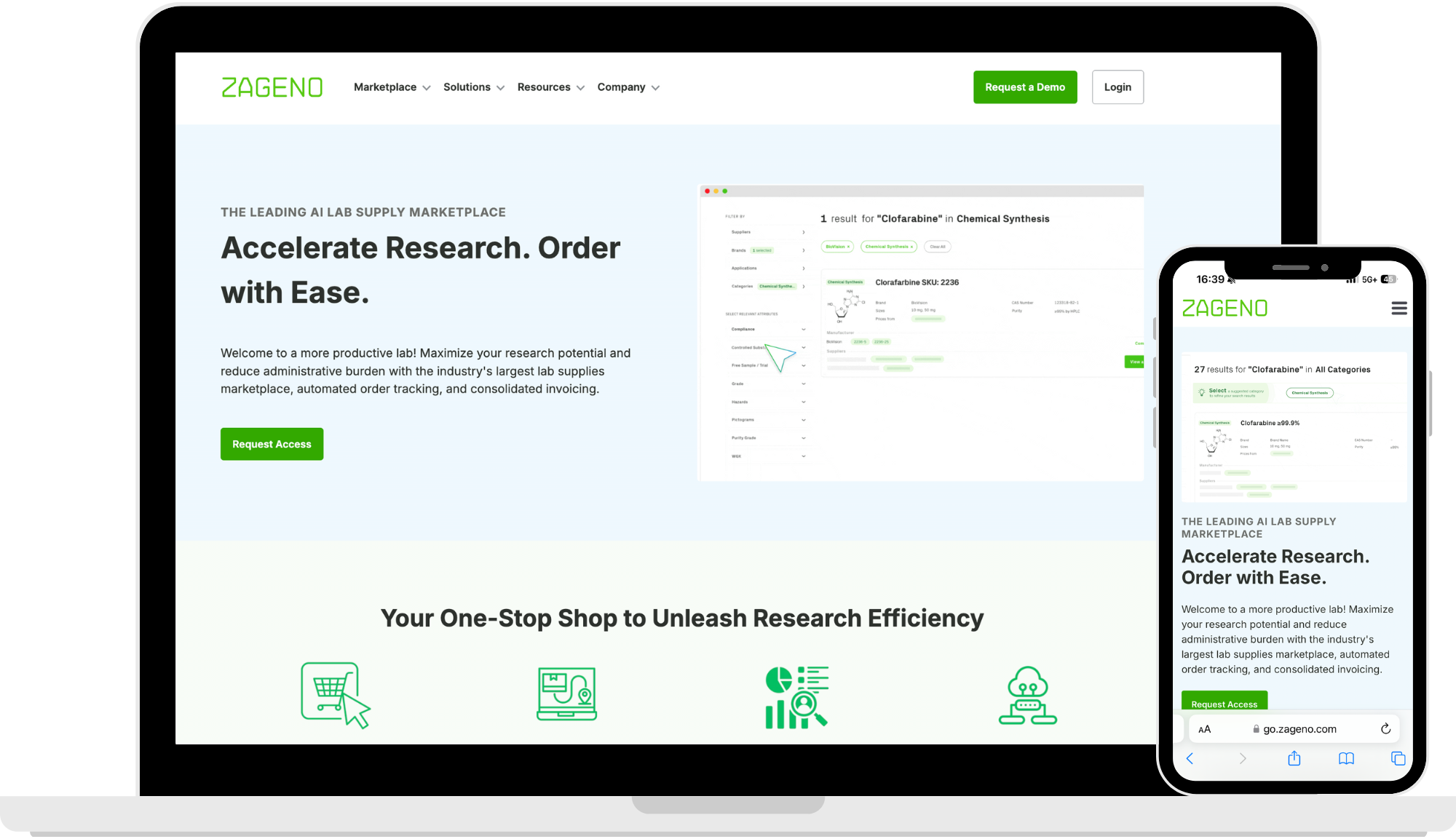
Purpose-built platforms like ZAGENO turn these advanced AI capabilities into practical realities. By uniting over 50 million product SKUs from more than 6,000 trusted brands into a single interface, ZAGENO enables research teams to leverage conversational discovery, advanced chemical searches, and automated substitute recommendations in one centralized hub.
Instead of toggling between isolated punchouts, scientists can build a single, multi-supplier metacart routed through a unified approval flow. This automated approach eliminates manual overhead with 3-way invoice matching—reclaiming up to 6.5 hours per week for scientists and 3 days per week for lab managers. Ultimately, the true value of AI-enhanced procurement isn't just a faster order cycle; it ensures scientists always have the precise, compliant tools they need to keep their work moving forward.
Related resources