

Scientists are routinely celebrated for discoveries, experiments, and breakthroughs. Research Operations teams rarely are. Yet, behind every successful experiment sits an intricate network of people, systems, suppliers, workflows, and processes ensuring researchers have what they need, exactly when they need it.
As pharmaceutical and biotech organizations grow more complex, Research Operations has evolved far beyond basic laboratory logistics. Today’s teams orchestrate complex scientific workflows spanning researchers, procurement, finance, IT, suppliers, and increasingly, AI-enabled systems.
Most of this work is entirely invisible. But without it, science slows. While scientists design experiments, Research Operations creates the foundational conditions that allow those experiments to happen.
Research Operation as a cross-functional leadership role
Modern research organizations face intensifying pressure to accelerate discovery while managing global teams, expanding technology stacks, and navigating a steep curve of operational complexity.
Because of this, Research Operations teams have become the vital connective tissue keeping research organizations aligned and productive. On any given day, they are responsible for coordinating:
- Scientific software and technology stacks
- Cross-functional operational processes
- Supplier relationships and purchasing infrastructure
- Budgets and financial collaboration
This requires a delicate balancing act, as they sit at the intersection of competing stakeholder priorities:
- Scientists want speed and flexibility.
- Procurement needs governance and compliance.
- Finance requires strict budget control.
- IT prioritizes security and seamless integration.
This cross-functional orchestration is particularly vital as organizations look toward the future. According to the Deloitte 2026 Life Sciences Outlook, nearly 80% of life sciences executives expect AI to drive significant organizational change. Yet only 22% report successfully scaling AI initiatives, and just 9% have achieved significant returns.
The invisible burden researchers rarely see
While researchers ideally focus entirely on the science, Research Operations teams focus on everything required to sustain it.
A typical day for a Research Ops professional might involve onboarding new suppliers, supporting lab relocations, implementing software, standardizing purchasing processes, resolving order discrepancies, preparing for compliance audits, or managing inventory bottlenecks.
Much of this effort goes unnoticed because, when done well, the organization simply runs smoothly. Friction only becomes visible when a process fails:
- A delayed shipment postpones a time-sensitive experiment.
- A disconnected software system creates hours of duplicate work.
- A missing approval workflow leaves a scientist waiting for critical materials.
Research Operations teams work continuously behind the scenes to prevent these disruptions.
Growth amplifies operational complexity
Research organizations rarely become simpler as they scale. New sites open, software platforms multiply, and supplier networks expand. Teams become geographically distributed and operational processes that worked seamlessly for a twenty-person startup quickly break down at enterprise scale. The result is frequently a patchwork of systems, suppliers, and workflows that becomes highly difficult to manage.
The National Academies of Sciences, Engineering, and Medicine have emphasized the critical need to reduce unnecessary administrative burden while maintaining scientific rigor and compliance. As organizations scale, Research Operations teams step in to focus on standardization, process improvement, and operational consistency, ensuring organizational growth does not come at the expense of researcher productivity.
Why strategic scientific procurement is a research ops priority
Scientific procurement has traditionally been viewed as a procurement responsibility. That dynamic is changing. Research Operations leaders increasingly recognize that purchasing processes directly affect researcher productivity, workflow efficiency, experimental timelines, and overall research continuity.
When researchers have to navigate multiple supplier websites, manually compare products, track orders through fragmented email threads, or wrestle with disjointed systems, they spend less time at the bench.
Modern scientific procurement platforms help simplify these experiences, standardize processes, improve visibility, and reduce administrative burden. By introducing capabilities like guided buying, centralized supplier access, automated approvals, and integrated workflows, they reduce administrative friction and create a more consistent research environment.
When evaluating these solutions, organizations often find it useful to compare lab procurement platforms and lab management software. Research organizations must ensure that purchasing workflows connect effectively with enterprise systems through robust lab ERP and P2P integrations.
Becoming organizational orchestrators
Research Operations leaders do more than manage logistics; they coordinate people, systems, suppliers, and processes into a cohesive operating model.
| Stakeholder | Primary Focus |
|---|---|
| Scientists | Research execution |
| Procurement | Governance and supplier strategy |
| Finance | Budget and approvals |
| IT | Systems and integrations |
| Facilities | Laboratory readiness |
| Suppliers | Materials and fulfillment |
| Research Operations | Cross-functional coordination |
By connecting laboratory software, inventory systems, procurement processes, and enterprise applications, Research Ops creates a seamless path from scientific intent to physical execution.
To explore how technology is currently reshaping laboratory purchasing, review AI in Lab Procurement: How AI Is Transforming Scientific Purchasing.
Research operations in the age of AI
AI is completely transforming how researchers analyze data, generate hypotheses, and design experiments. However, AI-generated scientific intent still fundamentally depends on physical execution. Experiments still require physical reagents, consumables, operational equipment, vetted suppliers, budget approvals, and compliant purchasing workflows.
Organizations investing heavily in AI must ensure their operational workflows evolve alongside their scientific workflows. Otherwise, highly sophisticated scientific systems risk being constrained by fragmented operational infrastructure. Research Operations teams are uniquely positioned to bridge this gap, helping organizations realize the full value of their technology investments.
The future of research operations
The strategic role of Research Operations will only continue to expand. Looking forward, high-performing teams will increasingly focus on:
- Researcher enablement to optimize bench time
- Workflow standardization across global sites
- Operational resilience against supply chain disruptions
- Scientific procurement strategy to align spend with science
- Cross-functional collaboration between labs and back-office teams
- Technology adoption and change management
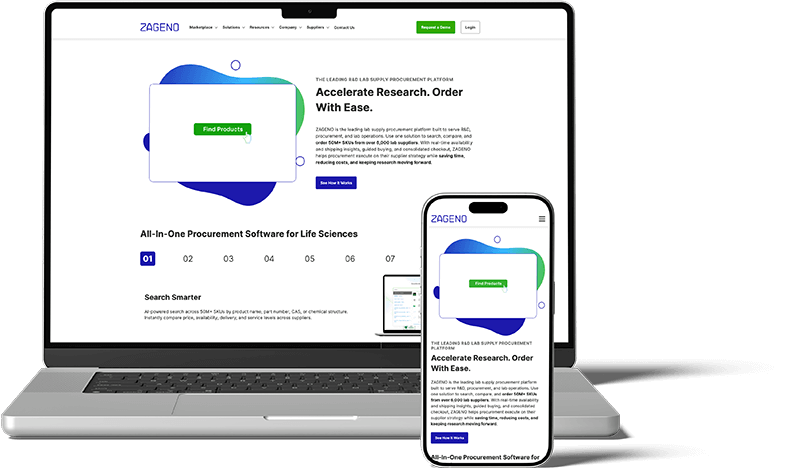
Ready to modernize your research operations?
Organizations looking to modernize operations across global R&D teams can leverage ZAGENO’s specialized support for pharmaceutical and biotech research organizations.
ZAGENO helps life sciences organizations simplify scientific procurement, connect enterprise systems, and build operational environments that empower researchers to spend more time on science. Request a demo today to learn how ZAGENO supports Research Operations teams and keeps science moving.
Frequently asked questions
-
What does a Research Operations team do?
Research Operations teams coordinate the people, systems, suppliers, and processes required to support scientific research. Key responsibilities typically include workflow optimization, technology management, scientific procurement, operational standardization, and cross-functional stakeholder coordination. -
Why is Research Operations becoming more important?
As research organizations scale, they inherently become more complex. Research Operations teams ensure that systems, processes, suppliers, and internal stakeholders remain completely aligned so researchers can work efficiently without administrative bottlenecks. -
How does Research Operations support scientists?
They proactively reduce administrative burden, standardize daily workflows, implement supporting laboratory technologies, coordinate with suppliers, and resolve the operational bottlenecks that would otherwise delay research. -
Why has scientific procurement become important to Research Operations teams?
Scientific procurement helps Research Operations teams reduce administrative burden, standardize workflows, and ensure researchers have timely access to the materials they need. -
How does AI affect Research Operations?
While AI revolutionizes data analysis and experimental design, physical execution still relies on infrastructure. Research Operations teams ensure that these advanced technologies integrate effectively into existing procurement and operational workflows so that physical laboratory execution can keep pace with digital acceleration.
Related resources