

Research organizations have invested heavily in technologies designed to accelerate discovery. Electronic Lab Notebooks (ELNs), Laboratory Information Management Systems (LIMS), AI assistants, and advanced analytics platforms are transforming how experiments are designed, documented, and analyzed.
Despite these investments, many scientists still spend a surprising amount of time on activities unrelated to science itself: searching supplier websites, tracking orders, managing backorders, onboarding vendors, and resolving purchasing issues. For Research Operations teams, this presents a growing challenge: every hour researchers spend navigating administrative processes is an hour taken from advancing programs.
Increasingly, Research Operations leaders are recognizing an important truth: improving researcher productivity requires more than scientific software, it also requires modern operational infrastructure.
Why boosting R&D velocity is a strategic priority
Pharmaceutical and biotech organizations face mounting pressure to accelerate research while managing increasing scientific complexity. Modern research programs depend on a growing ecosystem of technologies, external partners, suppliers, and distributed teams.
According to McKinsey, improving R&D productivity remains a top priority for life sciences organizations as they seek to speed up development timelines and bring therapies to market more efficiently.
Research Operations teams are increasingly responsible for:
- Improving researcher experience
- Reducing administrative burden
- Standardizing workflows across sites
- Supporting AI-enabled research initiatives
- Ensuring operational continuity across global research organizations
- Increasing research productivity
The goal is straightforward: help scientists spend more time on science.
Scientists need more than laboratory software
Over the past decade, life sciences organizations have made substantial investments in:
- Electronic Lab Notebooks (ELNs)
- Laboratory Information Management Systems (LIMS)
- Data and analytics platforms
- Inventory management systems
- AI-enabled research tools
These technologies have transformed how experiments are planned and analyzed. However, a critical gap often remains between scientific intent and scientific execution.
A scientist may identify the next experiment in an ELN but successfully executing that experiment still depends on obtaining the right materials, sourcing approved suppliers, navigating internal purchasing policies, and ensuring products arrive on time. If those processes are fragmented, research slows.
Organizations evaluating new laboratory technologies should consider how those systems integrate with procurement workflows. Research teams evaluating new systems should understand the differences between lab procurement platforms and lab management software.
The hidden bottlenecks stalling day-to-day lab work
Many life sciences organizations still rely on a patchwork of supplier portals, spreadsheets, emails, manual approvals, and disconnected purchasing systems. As organizations scale, these inefficiencies compound.
4 common challenges include:
Research operations in the AI era
AI is rapidly changing how research is conducted.
Scientists increasingly use AI to:
- Analyze scientific literature
- Generate hypotheses
- Design experiments
- Interpret results
- Identify promising therapeutic candidates
However, AI-generated scientific intent still depends on physical execution. Experiments require reagents, consumables, equipment, and approved suppliers. In many organizations, procurement remains disconnected from AI-driven research workflows, which creates a productivity bottleneck the lab of the future cannot tolerate.
As organizations invest in enterprise AI initiatives, Research Operations leaders are increasingly evaluating how procurement infrastructure can become part of connected, AI-enabled scientific workflows rather than remaining a separate administrative process. Organizations exploring this evolution should understand how AI is transforming scientific purchasing.
Biopharma leaders increasingly view technology as central to future competitiveness. Deloitte’s 2026 Life Sciences Outlook found that nearly 80% of life sciences executives expect AI to play a central role in driving major organizational change, underscoring the growing importance of connected, AI-enabled research workflows.
Why traditional procurement tools were not built for research
Traditional ERP and procure-to-pay systems play an important role in financial governance, compliance, and enterprise purchasing. However, they were not designed around the unique needs of scientific users.
Researchers expect purchasing experiences that are fast, intuitive, search-driven, embedded within existing workflows, and capable of supporting highly specialized scientific products. Research organizations increasingly require solutions that combine enterprise governance with consumer-grade user experiences.
This is one reason many organizations are moving toward scientific procurement models that connect researchers, suppliers, procurement teams, and finance functions through a unified experience. To bridge this gap, leading teams prioritize lab ERP and P2P integrations that naturally connect day-to-day experimental workflows with core enterprise purchasing systems.
From fragmented systems to scientific procurement orchestration
Modern Research Operations teams are increasingly viewing procurement as part of the scientific workflow itself. Rather than forcing researchers to navigate fragmented purchasing processes, organizations are investing in infrastructure that connects:
| Traditional Approach | Research Operations Approach |
|---|---|
| Multiple supplier portals | Unified procurement layer |
| Manual purchasing | Guided buying and automation |
| Disconnected systems | Connected scientific workflows |
| Fragmented supplier relationships | Supplier orchestration |
| Administrative purchasing | Workflow-embedded scientific procurement |
This shift is often described as scientific procurement orchestration.
Scientific procurement orchestration connects:
- Scientific tools such as ELNs and LIMS
- Enterprise AI assistants
- Inventory systems
- Procurement and finance systems
- Suppliers and distributors
- Researchers and lab operations teams
The objective is not simply to purchase products more efficiently; it is to remove operational barriers that prevent researchers from moving quickly.
Increasingly, Research Operations teams prioritize capabilities such as:
- Unified search across suppliers
- Guided buying experiences
- Preferred supplier routing
- Automated approvals
- AI-assisted purchasing recommendations
- Supplier performance visibility
- Integrated purchasing workflows
Together, these capabilities create a more seamless path from scientific intent to procurement execution. Organizations interested in these capabilities should evaluate modern scientific procurement platforms.
Scientific procurement supports laboratory workflows
Laboratory workflows do not end when an experiment is designed. Researchers still need timely access to the materials, suppliers, and operational infrastructure required to execute that work.
As research organizations scale, fragmented purchasing processes can create hidden inefficiencies across laboratory workflows, including:
- Delayed experiments
- Duplicate purchasing activities
- Increased administrative burden
- Supplier inconsistency
- Reduced visibility across sites
Scientific procurement helps eliminate these inefficiencies by connecting purchasing directly to research operations. For many organizations, this represents an important shift.
Procurement is no longer viewed solely as a cost-control function. It is increasingly recognized as part of the operational infrastructure required to support modern research and improve lab operations efficiency across distributed research teams.
Essential criteria for a unified scientific platform
As organizations evaluate technologies designed to improve researcher productivity, Research Operations leaders should ask:
Helping scientists spend more time on science
Research organizations have invested heavily in technologies that improve how science is designed and analyzed. Increasingly, they are recognizing that the operational infrastructure supporting research matters just as much.
"The true measure of Research Operations isn't how many processes become more efficient. It's whether those improvements accelerate scientific discovery and create measurable business outcomes. When you give scientists a connected, intuitive experience that removes operational friction, they spend more time advancing science and less time navigating systems."
— Jon Zibell, Vice President of Global Alliances and Marketing, SciSure
Connected operational infrastructure makes that possible. When procurement processes become fragmented, scientists lose time, research programs slow, and organizations struggle to realize the full value of their scientific investments.
By reducing administrative burden, connecting workflows, and simplifying access to the materials researchers need, Research Operations teams can help scientists focus on what they do best: advancing science.
Organizations looking to modernize purchasing across global R&D teams should explore solutions purpose-built for pharmaceutical and biotech research organizations.
Frequently asked questions about research productivity
-
What is Research Operations in pharmaceutical and biotech organizations?
Research Operations (ResOps) is the strategic function that manages the infrastructure, technology, and processes required to keep research running efficiently. ResOps drives workflow optimization by streamlining laboratory workflows to maximize scientist productivity. Additionally, the function handles technology management by overseeing critical systems like ELNs, LIMS, and lab management software, while driving organizational standardization to establish consistent, compliant processes across global research sites -
Why do scientists spend so much time on administrative tasks?
Scientists lose valuable time because traditional purchasing tools and lab operations software are disconnected, forcing them to manually manage supplier websites, order tracking, and approvals. This operational fragmentation separates day-to-day laboratory workflows from the supply chain, creating a significant administrative bottleneck. -
How does procurement impact research productivity?
Procurement directly impacts research velocity because administrative delays in sourcing materials, onboarding vendors, or routing approvals postpone critical laboratory experiments. Enterprise research indicates that procurement delays stall up to 20% of experiments, costing scientists roughly 10% of their active time on the bench. -
What is scientific procurement?
Scientific procurement is the specialized process of sourcing, purchasing, and managing the technical laboratory supplies, biological reagents, and services required for R&D. Unlike standard enterprise purchasing, it is custom-built to support unique scientific workflows while maintaining corporate financial governance. -
What is scientific procurement orchestration?
Scientific procurement orchestration is the automated coordination of researchers, suppliers, finance systems, and scientific tools through a single, connected workflow. Instead of forcing teams across multiple supplier portals, it embeds procurement directly into lab tools (like ELNs and LIMS) to accelerate research. -
Why aren't traditional procurement systems sufficient for research organizations?
Traditional ERP and procure-to-pay (P2P) systems were built for corporate financial governance, not the unique, fast-paced needs of scientists. Research teams require intuitive, search-driven platforms that support specialized scientific products and integrate seamlessly into existing laboratory workflows.
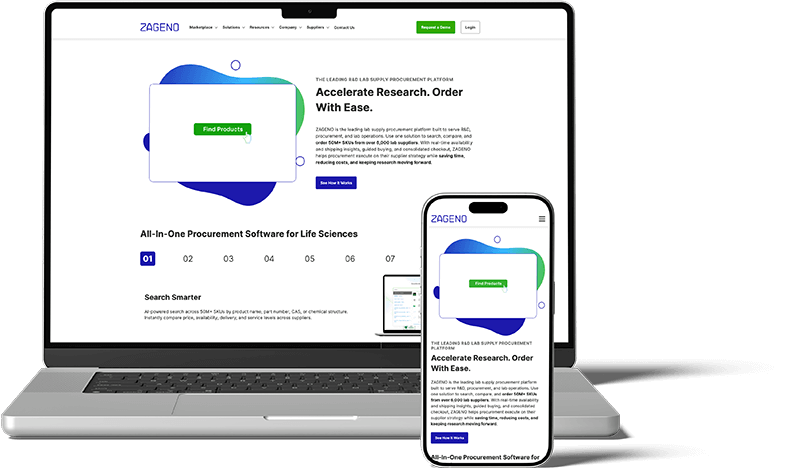
Orchestrate your scientific procurement with ZAGENO
ZAGENO helps pharmaceutical and biotech organizations connect researchers, suppliers, procurement teams, enterprise systems, and AI-enabled workflows through a single scientific procurement orchestration platform designed to keep research moving.
Request a demo to see how ZAGENO helps research teams reduce administrative burden, improve researcher productivity, and accelerate scientific progress.