
Research organizations rarely buy everything from a single supplier. A growing pharma or biotech team may source antibodies from one vendor, cell culture reagents from another, specialty chemicals from several more, and equipment from dozens of additional suppliers.
At first, buying through each supplier’s own portal feels manageable. But as supplier counts, users, sites, and approval requirements multiply, supplier-specific purchasing creates friction. The issue isn’t usually one bad supplier portal. It's the operational burden of managing too many separate purchasing experiences at once.
At what point do supplier-specific purchasing portals become cumbersome, and why do research organizations adopt centralized procurement platforms instead?
Key takeaways
Why supplier portals become difficult to scale
Supplier portals are designed for direct purchasing from a single supplier. They support product search, order placement, shipment tracking, contract pricing, and reorders within that specific supplier’s catalog.
While this direct model works when purchasing is simple, it becomes a liability when research teams scale to dozens, hundreds, or thousands of suppliers. Each supplier portal has its own login, search experience, ordering process, invoice format, and support path. Over time, researchers spend more time navigating portals, procurement teams lose visibility, and finance teams reconcile more disconnected transactions.
That is often the point when organizations begin evaluating centralized procurement.
The tipping point: When supplier portals stop scaling
Supplier-specific purchasing becomes a hindrance to growth the moment the administrative overhead surrounding a purchase becomes larger than the transaction itself.
Signs your lab has outgrown supplier portals:
This is especially common in pharma and biotech because scientific purchasing is inherently specialized. Researchers need flexibility, but the business needs control. A portal-only model often supports the first requirement better than the second.
Organizations seeking to balance both can explore additional strategies in our guide to Supplier Consolidation for Lab Procurement.
The hidden cost of portal sprawl
For a single order, a localized delay or occasional invoice mismatch may not matter much. Across thousands of annual orders, however, these small inefficiencies compound into a significant operating model problem.
Procurement leaders are already investing in digital tools to address these kinds of issues. According to Deloitte’s 2025 Global Chief Procurement Officer Survey, leading procurement organizations consistently outperform followers across cost savings, cost avoidance, stakeholder satisfaction, supplier performance, and innovation enablement. Notably, Deloitte found that 64% of respondents prioritized greater supply-chain visibility as a core risk mitigation strategy.
One purchasing workflow across suppliers
A centralized lab procurement platform introduces a single, unified workflow layer over your entire supplier network. Instead of bouncing from portal to portal, teams gain a single-entry point to search, compare, order, approve, track, and analyze all purchasing activity.
|
Feature / Capability
|
Supplier Portals
|
Centralized Procurement Platforms
|
|---|---|---|
|
Purchasing Focus |
Optimized for single-supplier transactions. |
Optimized across the entire supplier ecosystem. |
|
User Experience |
Fragmented (multiple logins, formats, and tracks). |
Unified (one interface to search, compare, and order). |
|
Spend Control |
Limited to supplier-specific activity. |
Comprehensive view across all teams, sites, and lines. |
|
Compliance |
Hard to enforce across disparate systems and sites. |
Automated approval routing and strict audit trails. |
These architectural differences allow procurement teams to effectively guide buying behavior without restricting scientific choice or forcing researchers into narrow supplier lists.
For more background, see ZAGENO’s guide to what a lab procurement platform is.
Data-driven scaling
As organizations grow, procurement leaders need answers to questions that supplier portals cannot provide:
- Where is aggregate spend actually going?
- Where is off-contract buying occurring?
- How do purchasing trends differ by project, team, or site?
- Are there definitive audit trails to support internal controls, grant requirements, and regulated research environments?
A centralized procurement platform helps consolidate those data points into one view, which aligns with broader procurement technology trends. Recent Gartner research (summarized by Supply Chain Management Review) highlights that 72% of CPOs identify data and analytics technologies as a top investment priority, while 68% are prioritizing AI and generative AI capabilities.
For specific operational guidance, explore our Lab Procurement FAQ for Pharma & Life Sciences.
Reducing integration and IT complexity
Beyond workflows, relying solely on individual supplier portals introduces serious technical complexity.
Most mid-market and enterprise organizations depend on core ERP and P2P systems like SAP Ariba, Coupa, or Jaggaer. When each supplier requires its own custom punchout, dedicated catalog connection, or manual maintenance schedule, the burden on IT and procurement operations grows exponentially.
A centralized procurement platform eliminates this bottleneck by acting as a single, consolidated integration layer between researchers, suppliers, and enterprise systems. It preserves your existing supplier relationships while dramatically simplifying the day-to-day purchasing infrastructure.
Strategic sourcing, not supplier replacement
The OECD’s 2025 report on digital procurement underscores this, noting that modern digital transformation relies heavily on integrated platforms, workflow optimization, and administrative efficiency. While their findings focus on public frameworks, the underlying operational logic applies to complex enterprise purchasing environments.
For pharma and life sciences teams, the end goal is simple: preserve necessary scientific flexibility while giving procurement, finance, and operations the centralized visibility and control they need to grow.
Take control of your lab’s purchasing ecosystem
Managing dozens of disconnected supplier portals might work for a small lab, but it quickly becomes an operational bottleneck for a growing research organization. By centralizing your workflows, you can eliminate portal sprawl, give finance and procurement leaders total spend visibility, and—most importantly—give your scientists more time to focus on discovery.
Don’t let administrative burden slow down your research.
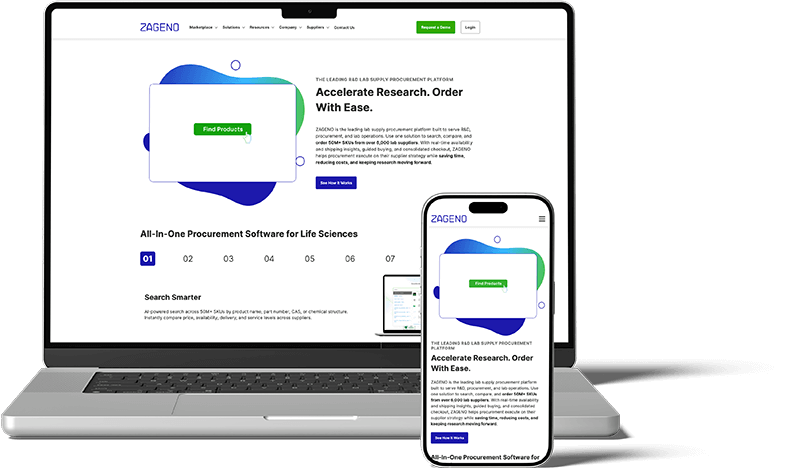
Ready to transition from disconnected portals to a scalable platform? Schedule a demo with ZAGENO today to see how we can unify your procurement workflow, integrate with your existing ERP/P2P systems, and simplify your scientific purchasing.
Frequently Asked Questions
-
What is the difference between supplier portals and lab procurement platforms?
Supplier portals support purchasing from one supplier. Lab procurement platforms centralize purchasing, approvals, reporting, and spend visibility across many suppliers. -
When do supplier portals stop scaling?
They generally stop scaling when an organization begins managing a high volume of suppliers, multiple laboratory sites, manual approval bottlenecks, compounding invoice volumes, and fragmented spend visibility. -
Do procurement platforms replace our existing supplier relationships?
No. Modern procurement platforms preserve your strategic supplier relationships and contract pricing while routing the transactions through a single, manageable workflow. - How do procurement platforms reduce portal sprawl?
They consolidate the purchasing lifecycle—giving teams a single hub to search, compare, approve, track, and report on orders across hundreds of vendors instead of maintaining separate logins for each. - Are punchout catalogs the same as procurement platforms?
No. A punchout catalog is simply a digital connection method linking a single supplier’s catalog to an ERP or procurement system. A procurement platform manages the broader end-to-end purchasing workflows, approvals, and compliance policies across all suppliers simultaneously.
Related resources