

Scientists rarely bypass procurement because they want to ignore the rules. More often, they need an exact reagent, assay, instrument part, or specialist supplier, and the approved route makes that item difficult to find or slow to order.
When researchers buy outside the approved process, the result is maverick spend. For procurement, the answer is not simply tighter enforcement. It is a purchasing experience that gives scientists the access and speed they need while keeping spend visible and governed.
Why maverick spend looks different in pharmaceutical R&D
Scientific products are not interchangeable office supplies. Researchers may require a specific concentration, grade, formulation, clone, pack size, or manufacturer because the choice can affect an experiment. A peer-reviewed study of research rigor and reproducibility notes the importance of validated reagents and well-documented experiments in producing reliable results.
At the same time, R&D purchasing spans a long tail of specialized products and suppliers. Needs can change quickly as protocols evolve, results redirect a project, or an experiment must be repeated. Standard catalogs and rigid workflows often struggle to keep up.
This is why life sciences procurement must balance control with scientific choice. If the approved route cannot support both, researchers will find another route.
Why researchers buy outside the approved process
These are adoption problems as much as policy problems. If a process repeatedly sends scientists elsewhere, procurement needs to examine the process, not only the purchase.
The costs go beyond the purchase price
An off-contract order may cost more than the negotiated option, but the broader effect is often more significant. Procurement loses visibility into demand. Finance must reconcile more suppliers and invoices. Similar purchases become harder to combine, and teams may repeat supplier onboarding or negotiate from incomplete data.
How to identify maverick spend in pharmaceutical R&D
Start by comparing purchasing activity with contracts, preferred suppliers, approval rules, and established buying channels. Useful signals include:
- Spend placed with non-preferred or non-contracted suppliers.
- Non-PO invoices and purchase orders created after an order was placed.
- Purchasing-card or emergency orders for routinely purchased items.
- Repeated supplier-addition requests for the same categories.
- Large price differences for equivalent products across teams or sites.
- Categories with frequent approval exceptions or manual workarounds.
Do not stop at the total. Segment the results by site, department, category, supplier, and reason for exception. A high number of off-contract purchases in one category may point to missing catalog coverage. A cluster at one site may indicate a workflow or training issue. The pattern usually says more than the percentage alone.
How to reduce maverick spend without slowing scientists
Where AI can help
AI can support this work without making purchasing decisions on its own. It can interpret a researcher's request in plain language, surface preferred products, identify possible alternatives, route an exception, or flag unusual purchasing patterns for review. APQC's review of AI in procurement includes spend analysis, duplicate-purchase detection, and identification of non-compliant suppliers among the practical use cases.
Measure control and speed together
A program is not successful if off-contract spend falls but ordering takes longer. Track adoption and research support alongside financial control:
- Percentage of spend with preferred or contracted suppliers.
- Time from request to approved purchase order.
- Exception volume, reasons, and resolution time.
- New-supplier requests and repeated supplier additions.
- Price variance for commonly purchased products.
- Researcher adoption and satisfaction with the approved process.
Better control starts with a process scientists will use
The goal is not perfect compliance on paper. It is an approved purchasing path that works in the real world of pharmaceutical R&D. When researchers can find the exact product, use the right supplier, request a legitimate exception, and keep work moving, procurement gains control because the process earns adoption.
Frequently asked questions about maverick spend
- What is the difference between maverick spend and rogue spend?
The terms are often used interchangeably for purchases made outside approved processes, contracts, or suppliers. Rogue spend can imply deliberate rule-breaking, while maverick spend may also result from missing products, slow approvals, unavailable suppliers, or a purchasing process that does not fit the user's need. - How do I identify off-contract pharmaceutical spend?
Compare invoice, purchase-order, purchasing-card, supplier, and contract data to identify transactions outside preferred agreements or approved buying channels. Then segment the results by category, site, supplier, and exception reason to find the process gaps driving the spend. - How can procurement software prevent unauthorized purchases?
Procurement software can guide users toward approved products and suppliers, apply approval rules, connect requests with budgets, and maintain a visible exception process. It is most effective when the approved workflow is faster and easier than buying outside it. - How can pharma procurement reduce maverick spend without slowing research?
Give scientists a single place to find scientific products, apply preferred-supplier guidance during search, provide fast exception routing, and connect the experience with existing ERP and procure-to-pay controls. Measure ordering speed and researcher adoption alongside off-contract spend.
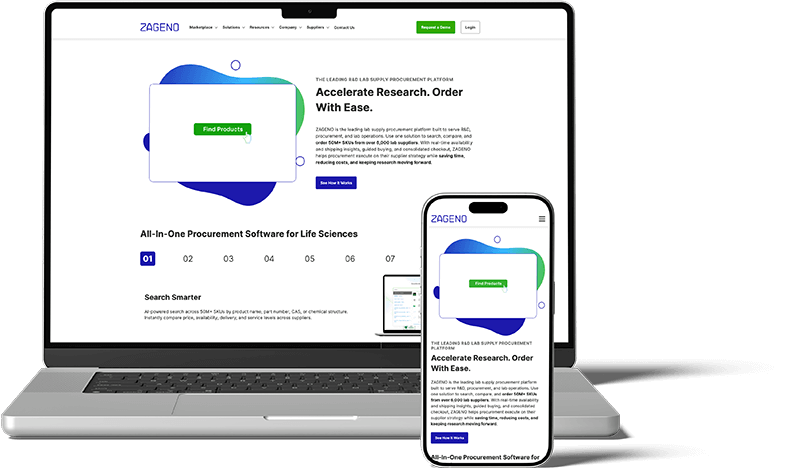
Reduce off-contract lab spend without adding complexity
ZAGENO helps pharmaceutical and biotech organizations bring scientific supplier access, guided buying, approval workflows, and enterprise integrations into one connected purchasing experience. Request a personalized demo.