
Skip to content

7 Tests for AI-Powered Lab Procurement in Pharma R&D

scientist receiving lab supplies aided by AI

A scientist needs an exact reagent by Friday. The preferred distributor can’t supply it in time. Another supplier lists the product under a different description, and the purchase needs approval before an order can be placed.

That is a useful scenario to bring to a procurement demo.

For pharmaceutical R&D teams evaluating an AI procurement platform, the important questions arise where scientific requirements, supplier options, and purchasing rules meet. Can the researcher find the correct item? Does the preferred-supplier policy still apply? Who resolves the exception, and what happens to the request next?

ZAGENO approaches these questions through AI-powered scientific procurement orchestration: connecting researchers, scientific suppliers, purchasing guidance, and existing enterprise systems. When evaluating this kind of solution, it’s important to test the full purchasing experience, including the work handled by AI, configured rules, integrations, and people.

To evaluate AI-powered lab procurement, bring seven scenarios to the product demonstration: an exact-product request, a supplier comparison, an availability exception, a proposed substitution, an approval change, a system handoff, and an order delay. Ask to see the result and the supporting information for each.

  1. Can it preserve the scientific specification?

    Start with a request that includes a manufacturer catalog number, grade or formulation, pack size, quantity, and required date. Add a similarly named product that differs in one important attribute. Then remove one detail from the request and repeat it.

    This tests both matching and uncertainty. A useful response preserves the requirements provided and makes missing information visible. An incomplete request should lead to clarification before a consequential product choice is made.

    Ask to see: The manufacturer identifier and specifications behind the recommended product, along with any unresolved requirements.

    For procurement, the practical question is whether scientists must repeat their product research after receiving a recommendation. If they still need to reopen supplier websites to establish which item was selected, account for that work in the evaluation. If the proposed setup accepts requests from an electronic laboratory notebook (ELN), laboratory information management system (LIMS), or conversational interface, run the same request through that route to confirm which details reach the purchasing workflow.

  2. Can it make a valid comparison across suppliers?

    Present two supplier listings for the same manufacturer product. Use different descriptions or pack sizes so the comparison requires more than matching names. For example, one listing might offer ten 1 mL vials for $120, while another offers five for $105. The lower pack price is the higher price per milliliter. This illustrative comparison becomes more complicated when shipping, minimum quantities, or contract terms differ.

    Ask to see: How the platform establishes product identity, compares quantities, and presents the commercial information available for each option.

    Where pricing or availability comes from a connected source, ask where it originates and how it is updated. Missing information should remain identifiable so the buyer knows what still needs checking. This is one practical application of supplier orchestration: making product information and purchasing options usable across a varied scientific supplier network.

  3. What happens when the preferred supplier can’t meet the deadline?

    Take the same exact-product request and change the preferred supplier's availability. The experiment still needs the material by Friday. Ask the provider to walk through the next decision. Does the system identify other sources for that item? How does it represent delivery information? What happens if the available source falls outside the preferred-supplier policy?

    Ask to see: The policy applied, the permitted options, and the route for requesting an exception.

    The request should retain its scientific requirements and timing as it moves to the reviewer. Otherwise, the researcher may need to explain the situation again in an email, outside the purchasing record. ZAGENO's guided buying approachconnects product selection with preferred suppliers, negotiated pricing, and purchasing rules. A demonstration should show how that guidance would work with your organization's actual priorities and exception process.

  4. Can it distinguish a possible alternative from an approved substitute?

    Make the exact product unavailable and introduce an alternative with a different formulation, grade, or other relevant characteristic. Finding a candidate alternative is useful; determining whether it is suitable for a particular experiment requires scientific judgment.

    Ask to see: The differences presented to the researcher, the approval required, and what prevents a consequential substitution from proceeding without that review.

    This test helps establish the boundary between assistance and action. It also makes the role of agentic AI in pharmaceutical procurement concrete: which steps can it coordinate, and which decisions remain with a person? The NIST AI Risk Management Framework provides a voluntary foundation for evaluating trustworthiness throughout an AI system's lifecycle. For a procurement evaluation, apply that principle by identifying who is responsible for the recommendation, the review, and the eventual purchasing decision.

  5. Do purchasing controls follow the request?

    Run a representative purchase through two different approval conditions. For example, use a project with a different spending threshold or a site with a different preferred-supplier agreement. If the proposed workflow allows AI to take actions, ask what changes when the user lacks permission to perform one of them.

    Ask to see: Where the relevant rule is maintained, which system applies it, and who approves the request.

    This is a coordination test across the proposed setup. Approval may happen in an existing P2P system, while product discovery and supplier guidance happen elsewhere. The provider should explain those responsibilities clearly. For pharma teams, this also helps distinguish purchasing-policy controls from scientific and quality reviews.

  6. Does the request arrive intact in the next system?

    Build a cart containing an exact product, a supplier choice, and a required project or cost-center code. Follow the request into the organization's ERP or P2P workflow. Check the information on both sides. Is the quantity unchanged? Does the correct supplier reference appear? What becomes of an attachment or approved quote that the buyer needs?

    Ask to see: The fields transferred, the system responsible for each record, and the steps someone takes if a transfer fails.

    The demonstration should make configuration requirements and manual work visible. Deloitte's discussion of agentic AI in sourcing and procurement emphasizes interoperability, data readiness, and human oversight. When reviewing ZAGENO's lab procurement integrations, confirm the connection method, exchanged information, and setup requirements for the systems your team uses.

  7. Can the team act on a change after the order is placed?

    Introduce a backorder, revised delivery estimate, or partial shipment. Ask what the researcher and procurement team would see and who would take the next step. A status update has practical value when the team can understand its source, assess the impact on the experiment, and identify who can resolve the issue.

    Ask to see: The available status information, how updates reach the user, and who owns follow-up with the supplier.

    ZAGENO's lab supplier management capabilities include access to order status, delivery dates, backorders, and shipping delays through a single sign-on. Use a representative order to examine the information available for the suppliers and systems in your proposed setup.

Keep a Record of What Was Demonstrated

Bring procurement, a Research Operations representative, and the relevant systems owner into the evaluation. Use approved sample data and agree on the expected outcome before each test. Capture the findings in a simple table:

Evaluation Record What to Capture
Scenario The request, constraint, and change being tested
Expected outcome What your organization needs the workflow to do
Observed outcome What happened during the live demonstration
Supporting information Product data, policy, status source, or transaction record shown
Human responsibility Who reviews a decision or resolves an exception
Dependency Configuration, integration, supplier coverage, or manual work required

Mark each outcome as Demonstrated, Requires Configuration, Handled Manually, or Not Demonstrated. This gives the buying team a shared baseline for evaluating pilot readiness.

Frequently Asked Questions

  1. How should pharma teams evaluate an AI procurement platform?
    Test realistic scientific purchasing scenarios using agreed requirements. Examine exact-product matching, supplier comparisons, policy exceptions, substitutions, approvals, system handoffs, and order changes. Record what the platform demonstrates, what requires configuration, and where human oversight remains necessary.
  2. Does AI-powered lab procurement replace an existing ERP or P2P system?
    No, it typically operates alongside existing systems. ZAGENO's orchestration approach connects scientific purchasing with enterprise procurement workflows. During evaluation, confirm which system owns approvals and transaction records, as well as what data passes between systems.
  3. Should AI approve a substitute reagent automatically?
    No. When a substitution could impact an experiment, it requires scientific review. AI assists by identifying candidate alternatives and presenting relevant parameters, while human stakeholders retain approval authority based on scientific context.
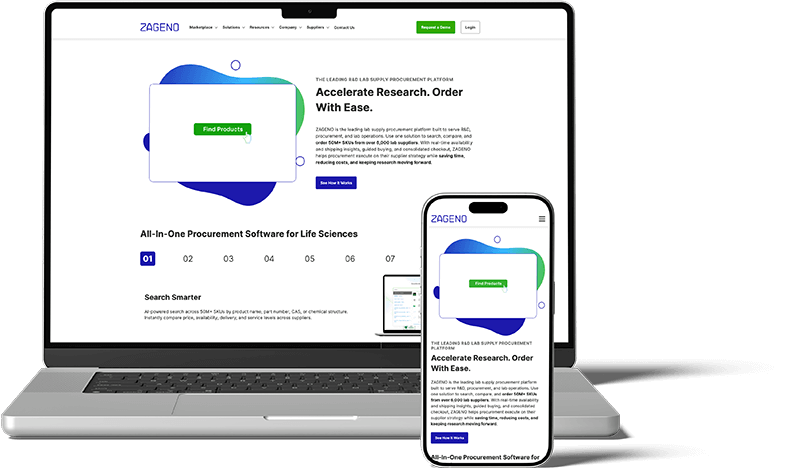
ZAGENO website homepage on laptop and mobile device

Bring Your R&D Workflow to the Demo

ZAGENO is an AI-powered scientific procurement orchestration platform for pharmaceutical and biotech R&D. It connects scientific supplier access, purchasing guidance, and enterprise workflows so researchers and procurement teams work through a coordinated buying experience.

Bring an exact-product request, a supplier exception, and an integration requirement. See how ZAGENO handles your R&D purchasing workflow.

See how ZAGENO handles your R&D purchasing workflow.

All your lab needs in one place

Access 50,000,000 products in one shop!

Trusted by thousands of scientists, lab managers, procurement and finance teams, ZAGENO's marketplace will help you search and order quickly in one go. Reach out for a demo today!