
Pharmaceutical R&D depends on a supplier network that is both broad and highly specialized. Researchers may need an exact reagent tied to a validated protocol, a custom product available from only one manufacturer, or a fast alternative when a preferred item is unavailable. Procurement still needs to apply purchasing policies, manage risk, control spend, and maintain reliable data across every transaction.
That creates a difficult balance. Limiting suppliers can restrict scientific choice, but allowing every supplier to operate through a separate process creates more work for researchers, procurement, and finance.
What is supplier orchestration?
The goal is not simply to manage more suppliers or reduce the supplier count. It is to make a diverse network operate through a coordinated purchasing environment.
Why pharmaceutical R&D needs a different supplier model
Large pharmaceutical organizations can work with thousands of third parties. GSK reported more than 18,000 third-party suppliers in 2025, illustrating the scale that global organizations may need to coordinate.
Scientific purchasing adds another layer of complexity:
- Strict product requirements: Specifications are exact, and demand can shift with little notice.
- Long-tail purchasing: Many purchases fall outside a small group of strategic suppliers.
- Siloed enterprise systems: Research teams work across sites, laboratory tools (ELN/LIMS), procurement platforms, ERPs, and supplier portals.
Without a coordinated model, that complexity can lead to:
- Researchers searching across multiple supplier websites and catalogs
- Different purchasing processes across sites or departments
- Slow onboarding for niche or long-tail suppliers
- Inconsistent product, supplier, and purchasing data
- Limited visibility into supplier usage and committed spend
- Preferred supplier strategies that are difficult to apply when choices are made
These are common signs of a fragmented supplier ecosystem. Adding another supplier portal or approval rule may fix one step, but it does not connect the network.
What does supplier orchestration coordinate?
Supplier orchestration brings several distinct parts of the purchasing lifecycle together. Each can be managed separately, but the value comes from making them work together.
Supplier orchestration compared with related strategies
Supplier orchestration overlaps with several established procurement practices, but it serves a distinct purpose:
| Approach | Primary purpose | Key question addressed |
|---|---|---|
| Supplier management | Administer individual supplier relationships, records, onboarding, and performance | How do we manage each supplier effectively? |
| Supplier consolidation | Reduce or rationalize the number of direct suppliers | Which supplier relationships should we combine or remove? |
| Supplier diversification | Expand available sources to reduce risk and improve flexibility | Where do we need additional supply options? |
| Supplier orchestration | Coordinate access, data, rules, and workflows across the supplier network | How do we make the entire network work together? |
| Procurement orchestration | Connect the broader procurement process across people, policies, suppliers, data, and systems | How do we coordinate procurement from scientific need through purchasing and payment? |
An organization can use all five approaches. Procurement may consolidate transactional relationships through a supplier of record while maintaining access to thousands of specialized manufacturers. Orchestration coordinates how scientists interact with that network.
The distinction also mirrors the difference between completing individual tasks and coordinating the full process. See procurement automation vs. orchestration for a closer comparison.
Put these capabilities to the test with lab procurement demonstration scenarios that examine supplier comparisons, availability exceptions, and purchasing approvals.
What supplier orchestration looks like in practice
Consider a researcher who needs a specific assay kit. The preferred distributor is out of stock, but the product is available from a specialized supplier that has not been used by that site.
- In a fragmented process: The researcher searches multiple websites, emails procurement, submits a free-text request, and waits while several teams determine vendor onboarding. Scientific context can be lost across disconnected systems.
- In an orchestrated process: The researcher searches within a connected environment. The system identifies available options, applies preferred-supplier policies, preserves the exact product specs, and automatically routes the order through the correct exception and approval path.
The scientist gets the exact product needed to keep research moving, while procurement maintains total control over spend and supplier risk.
Five benefits of supplier orchestration in pharmaceutical R&D
What should organizations look for in a supplier orchestration solution?
When evaluating supplier orchestration solutions, look for platforms that offer:
- A single, unified entry point for preferred, strategic, and long-tail suppliers.
- Automated product and supplier data harmonization.
- Real-time guided buying embedded into the product search experience.
- Built-in support for catalog, non-catalog, and quote-based requests.
- Native integrations with ERP, P2P, ELN, LIMS, and inventory management systems.
- End-to-end analytics tracking spend patterns, compliance, and supplier reliability.
How supplier orchestration fits into Scientific Procurement Orchestration
Supplier orchestration focuses on coordinating the supplier network.
Scientific Procurement Orchestration is the broader framework. It connects scientific demand with product discovery, suppliers, procurement policies, approvals, enterprise systems, data, and AI across the purchasing process.
ZAGENO enables supplier orchestration within that larger model. Researchers gain one place to access products from strategic and specialized suppliers, while procurement can apply category rules, coordinate workflows, and maintain visibility through existing enterprise systems.
The result is not a smaller scientific ecosystem. It is one that is easier to use and govern.
Supplier complexity should not slow science
Pharmaceutical R&D will always depend on specialized suppliers. The answer is not to force every scientific purchase through a narrow catalog or expect procurement teams to manage thousands of disconnected relationships manually.
Supplier orchestration preserves product choice while applying procurement strategy and connecting supplier activity across the organization. Researchers can reach the materials they need, while procurement and finance gain the structure and visibility required to support R&D at scale.
Coordinate scientific purchasing with ZAGENO
Researchers should not have to understand the supplier network behind a purchase. ZAGENO brings product data, guided buying, supplier access, approvals, and enterprise integrations into one purchasing experience so scientific choice does not create unnecessary administrative complexity.
Request a personalized demo to see how ZAGENO supports supplier orchestration as part of a connected scientific procurement environment.
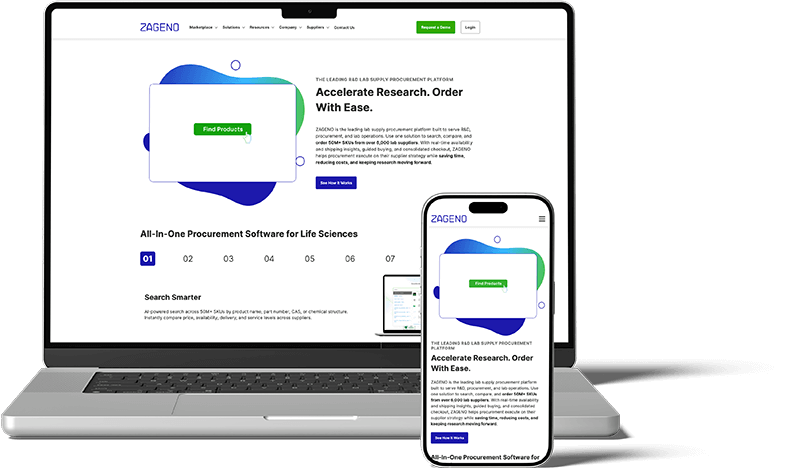
Give scientists choice without giving up control
A complex supplier network should not create a complex purchasing experience. ZAGENO gives researchers one place to access the products they need, while procurement and finance apply purchasing rules, connect workflows, and maintain visibility across existing systems.
Frequently asked questions about supplier orchestration
- What is supplier orchestration?
Supplier orchestration is the coordination of supplier access, product data, buying rules, workflows, and enterprise systems across an organization’s vendor network. It unifies disparate vendors into a single, controlled purchasing experience. - How is supplier orchestration different from supplier management?
Supplier management administers individual supplier performance, contracts, and onboarding records. Supplier orchestration connects those vendors across the enterprise, managing how scientists, procurement policies, and systems interact with the network in real time. - Does supplier orchestration require reducing the number of suppliers?
No. Organizations can consolidate direct transactional relationships while keeping access open to thousands of specialized vendors. The goal is unified governance and access, not limiting scientific access to materials. - Does supplier orchestration replace an ERP or P2P platform?
No. Supplier orchestration sits upstream and integrates directly with existing ERP and P2P platforms (like SAP and Coupa), keeping them as the core systems of record while optimizing the scientific buying experience.