

When you suggest investing in biotech procurement software, you might hear: “We already use so many platforms,” or “It’s not a priority.” Budget pressure is real, and procurement software doesn’t always rise to the top.
But what often gets missed is how inefficient procurement workflows drive up costs. Inconsistent pricing, fragmented vendors, protracted supplier onboarding, and low spend visibility can quietly drain budgets.
Biotech procurement software helps solve that. It gives you control over who buys what, where, and from whom. With accurate vendor data, budget controls, competitive pricing, and favorable terms, teams can cut waste and avoid costly delays.
To get buy-in, you need to shift from touting the key features of a new platform to the key outcomes. This guide walks you through how to build a persuasive, metrics-driven business case that will resonate with finance, lab operations, and R&D leadership alike.
7 steps to build a persuasive business case for biotech procurement software
1. Frame the problem like a business risk
You live the hassle of manual ordering, growing long tail spend, time-consuming supplier management, and delayed lab supply and scientific equipment shipments, but execs need to hear exactly how those problems affect the business.
🚫
Don’t just say: “We need to streamline procurement.”
👍
Instead, say: “We’re losing research time and increasing compliance risk because our procurement process isn’t centralized or traceable.”
Here’s how to reframe pain points:
- Lab downtime: Every delayed shipment puts research milestones at risk.
- Audit exposure: Spreadsheets and email trails don’t cut it for compliance.
- Time drain: Manual workflows waste high-value employee time.
Read more: Procurement Peace of Mind: How to Stay Compliant and Streamline Your Lab
2. Estimate the opportunity cost of inaction
Nothing kills a software pitch faster than vague benefits. Get specific. Estimate what current inefficiencies are costing in time and money:
🤷
How many hours does your team spend per week on ordering and approvals?
🤷
How many supply delays occurred last quarter?
🤷
How often do you have to track down order or vendor info manually?
Tip: Multiply those hours by average hourly cost to estimate labor impact. Include lost productivity and rework due to delayed or inaccurate shipments.
3. Connect procurement to strategic business goals
According to Gartner, 75% of ERP strategies are not strongly aligned with business strategy, a key reason why digital transformation initiatives fall short. Your leadership team cares about accelerating R&D, hitting milestones, staying audit-ready, and managing budgets. Your business case should connect the dots from procurement friction to these top-line priorities.
For example:
🎯
“Automated procurement will reduce turnaround time on critical orders, keeping our preclinical timeline on track.”
🎯
“With better spend visibility, we can negotiate stronger supplier contracts and forecast budgets more accurately.”
4. Highlight the added value of a biotech-specific platform
Generic procurement tools often fall short in biotech environments. They lack the supplier depth, category granularity, and scientific context needed to manage complex R&D purchases.
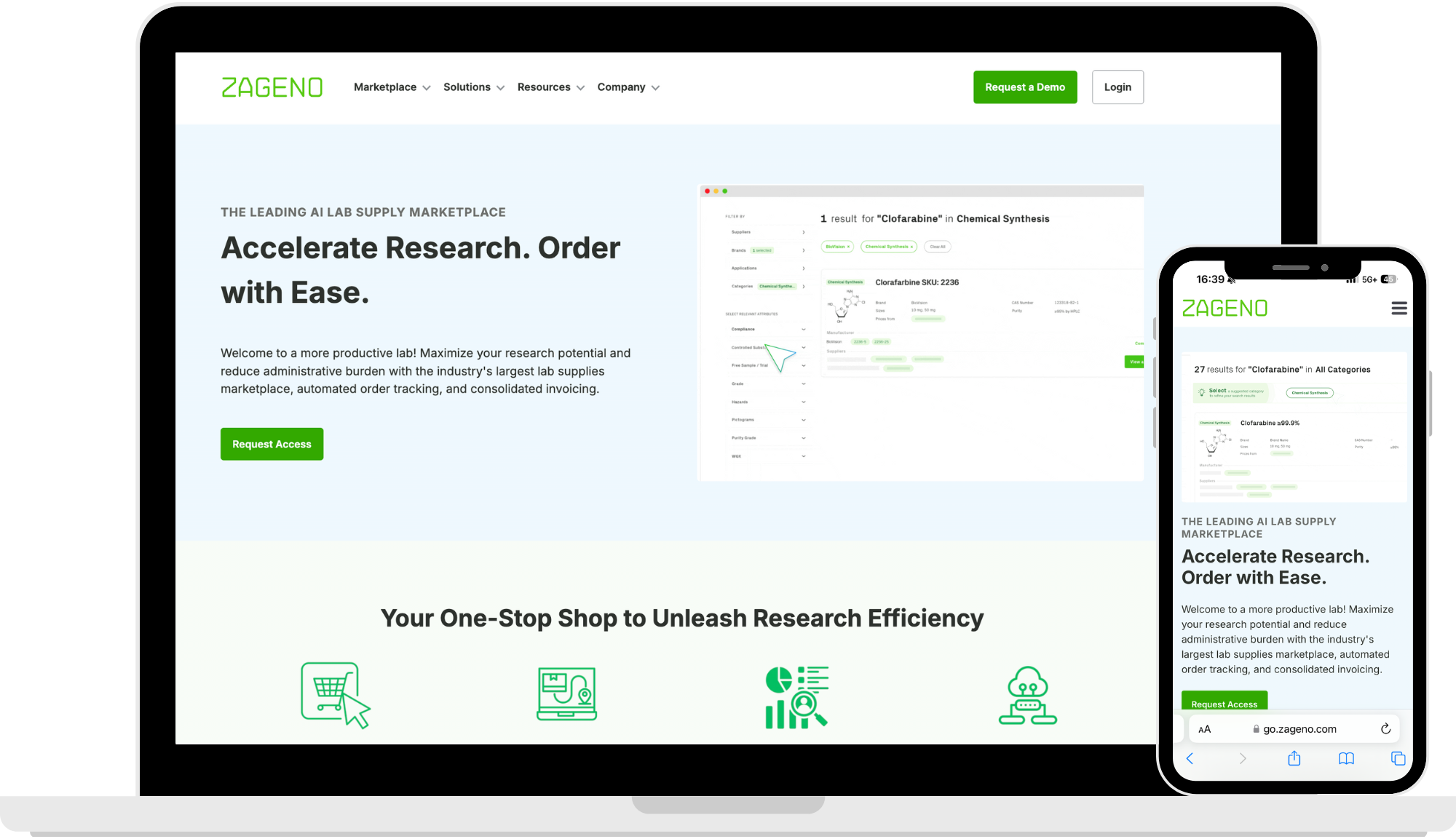
ZAGENO’s biotech procurement platform was built specifically for life sciences. It streamlines scientific purchasing while aligning with finance and operations. Key differentiators include:
🚀
Access to over 50M+ products and 6,000 life science suppliers through one marketplace
🚀
Real-time product availability, lead-time estimates, and side-by-side comparison tools
🚀
Guided buying workflows aligned with internal policies and cost center approvals
🚀
Smart routing to preferred suppliers
🚀
Automated PO generation and reconciliation
🚀
Seamless ERP and P2P integration to reduce IT friction and manual reconciliation
ZAGENO bridges the gap between lab autonomy and procurement control, enabling fast, compliant, and cost-effective sourcing. When the software fits your science, the business case becomes even stronger.
Read more: Choosing the Right Biotech Procurement Solution: 7 Questions to Ask
5. Show the ROI: Don’t just say it saves time, prove it
Leaders expect a return on investment. The good news is that procurement software delivers. Ask potential software providers to clearly demonstrate how their solutions deliver ROI.
For example, ZAGENO has provided customers with these validated results:
✅
15% annual cost savings per scientist on procurement expenses
✅
6.5 hours saved per week for lab managers on finding and ordering products
✅
Up to 70% less time spent by finance on 3-way matching tasks
✅
2–4 weeks saved per supplier during new supplier onboarding
✅
3 hours/week saved by procurement teams on reordering tasks
✅
40% less time spent by procurement on order tracking tasks
These tangible outcomes illustrate exactly how procurement software can translate directly into measurable benefits for your organization.
Tip: Highlight both direct (labor savings, reduced errors) and indirect benefits (faster R&D milestones, audit readiness).
Want to see how other biotech companies made the case?
Explore more metrics from biotech teams already using ZAGENO
6. Proactively address cost and implementation concerns
Expect questions like:
❓
“How much will it cost us this year?”
❓
“Will we need IT support or consultants to set it up?”
❓
“How quickly will we see value?”
Here’s how to answer:
👉
Highlight the low lift of SaaS solutions like ZAGENO (cloud-based, no infrastructure required)
👉
Share a phased rollout plan or pilot idea to manage cost and adoption risk
👉
Emphasize the vendor’s onboarding, training, and ongoing support
Bonus: Many platforms, such as ZAGENO, offer ERP and P2P integration, reducing the burden on IT and allowing faster syncing with your existing financial systems. Explore ERP and P2P integrations
7. Recommend KPIs to track post-launch
Show stakeholders that you’re not just asking for software, you’re committing to results.
Suggested metrics:
✅
% reduction in average order-to-receive time
✅
Increase in automated vs. manual orders
✅
Time saved by procurement or lab teams
✅
User satisfaction or system adoption rate
Frame this as part of a quarterly procurement performance dashboard you’ll share post-launch. With ZAGENO, much of this reporting is already built-in: users can track supplier fulfillment rates, time to delivery, order accuracy, and more in real time, with no need for custom report-building or IT support.
FAQs about Biotech Procurement Software
-
When should a biotech startup invest in procurement software?
A biotech startup should consider procurement software when manual purchasing begins taking significant staff time, supplier management becomes difficult, or limited spend visibility makes budgets harder to control. Implementing a scalable procurement process early can also help prevent these problems from growing as research programs, teams, and supplier networks expand. -
How do you build a business case for procurement software?
To build a business case for procurement software, quantify the cost of your current purchasing process and compare it with the expected value of a new platform. Consider time spent on ordering, approvals, supplier onboarding, invoice reconciliation, and tracking, along with purchasing delays, poor spend visibility, potential savings, and productivity gains. -
How should biotech companies calculate the ROI of procurement software?
Biotech companies should calculate procurement software ROI using both direct savings and operational value. Measure purchasing savings, reduced administrative work, fewer errors, and more efficient invoice processing alongside scientist time returned to research, faster access to critical supplies, stronger compliance, and fewer procurement-related research delays. -
Who should be involved in evaluating biotech procurement software?
A biotech procurement software evaluation should typically include procurement, Research Operations or lab operations, finance, IT, and researchers. Including the people who manage purchasing as well as those who use the process helps ensure the platform supports financial controls and governance without adding unnecessary work for scientists. -
What should biotech companies look for beyond software cost?
Biotech companies should evaluate the total business value of procurement software, not simply its subscription cost. Key considerations include supplier and product access, implementation requirements, ERP or P2P integrations, workflow automation, spend visibility, purchasing controls, scalability, and the amount of administrative time the platform can return to scientific and operational teams.
Shift the procurement conversation
Your team may see procurement software as a lifeline. Your leadership team may see it as a cost. Your job is to shift the conversation.
When you tie everyday inefficiencies to strategic business impact by supporting your case with metrics, ROI, and a clear roadmap, your business case won’t just be heard. It’ll be approved.
Ready to build your case? Let’s talk
A personalized ZAGENO demo will show you how our platform helps biotech teams save time, reduce costs, and streamline procurement from request to reconciliation. No matter your life sciences procurement goals, we’ll show you exactly how ZAGENO can help.
Related resources