
P2P systems, ERP modules, punchout catalogs, and marketplace platforms all claim to solve procurement—but most weren’t designed for how biotech labs actually operate.
This guide compares these options side by side, showing where each approach works, where it breaks down, and what to prioritize if your goal is faster, more controlled lab purchasing.
Common types of procurement solutions
Before comparing features and platforms, it's important to understand the different types of procurement solutions available. Each category brings its own strengths and limitations when applied to the fast-moving, compliance-sensitive world of biotech.
Procurement solutions compared
Here’s how the main biotech procurement approaches compare at a glance:
|
Feature |
Punchout Catalogs |
ERP Procurement Module |
P2P Systems |
General Marketplace Tool |
ZAGENO Biotech Platform |
|
Scientific Supplier Access |
Limited, manual add-ons |
Narrow, often generic |
Moderate, not R&D-specific |
Broad but not curated |
6,000+ life science suppliers |
|
Ease of Use for Labs |
Poor UX, ERP-centric |
Finance-focused |
Interface not lab-friendly |
Moderate, not R&D-specific |
Built specifically for life sciences |
|
Guided Buying & Routing |
Basic or manual |
Custom-coded workflows |
Moderate, may need config |
Inconsistent |
Smart routing by cost center, G/L code, etc., Customizable budget thresholds. |
|
ERP/P2P Integration |
Requires IT customization |
Built-in for finance use |
Native ERP/P2P integration |
May need middleware |
Seamless integration with major ERPs and P2Ps |
|
Backorder & Order Support |
Vendor-dependent |
Minimal |
Vendor-dependent |
Limited |
ZAGENO-managed support |
|
Consolidated Cart & Checkout |
No |
No |
No |
Often fragmented |
Yes. One PO, one invoice, one uniform set of payment terms across all suppliers. |
|
Invoice Matching |
Manual or external |
Partial automation |
Moderate automation |
Rare |
Automated 3-way matching between POs, invoices, and receipts. |
|
Onboarding New Suppliers |
Weeks/months |
High IT/admin burden |
Varies |
Varies |
Yes. 2–4 weeks saved on average. |
How ZAGENO works with (or without) other systems
ZAGENO is designed to flex around your existing procurement tech stack. Whether you’re using punchout catalogs, an ERP procurement module, or a full-scale P2P platform, ZAGENO can act as your lab-facing layer while syncing cleanly with back-end systems.
- Using punchouts? ZAGENO consolidates all suppliers into one meta-search and cart, eliminating the need to toggle between vendor-specific punchouts.
- Using ERP modules? ZAGENO plugs into platforms like SAP and Oracle to extend functionality to the lab without disrupting financial workflows.
- Running a P2P system? ZAGENO supports native integration to feed POs, invoices, and approval logic directly into your P2P workflows.
- No system in place yet? ZAGENO can serve as your standalone procurement hub, bringing structure and control without the cost or complexity of a full ERP.
Whether you need a turnkey solution or a modular upgrade to what you already use, ZAGENO brings flexibility and focus to biotech procurement.
Frequently asked questions about comparing biotech procurement tools
- What is a biotech procurement solution?
A biotech procurement solution helps life sciences teams source, compare, approve, order, and track lab supplies across suppliers. The best options support R&D purchasing needs while giving procurement and finance teams visibility, control, and integration with ERP or P2P systems. - What should biotech companies look for in procurement software?
Biotech companies should look for broad scientific supplier access, ERP or P2P integration, guided buying, approval routing, consolidated checkout, invoice matching, and support for backorders or supplier communication. The solution should make ordering easier for scientists without bypassing procurement policy. - Is P2P software enough for biotech procurement?
P2P software can support approvals, purchase orders, and invoice workflows, but it may not be enough for biotech teams on its own. Many P2P systems are not designed around scientific sourcing, lab-specific suppliers, or fast-changing R&D purchasing needs. - How is a biotech procurement platform different from a general marketplace?
A biotech procurement platform is built for scientific purchasing workflows, supplier management, approvals, integrations, and compliance. A general marketplace may offer product selection, but it usually lacks the scientific filtering, procurement controls, and lab-specific support biotech teams need. - Can biotech procurement software integrate with ERP and P2P systems?
Yes. Some biotech procurement platforms can integrate with ERP and P2P systems so purchasing data, purchase orders, invoices, approvals, and cost center information can flow between systems without forcing lab users to work directly inside finance-first tools.
Why biotech teams choose ZAGENO
ZAGENO was designed specifically for life sciences. That means everything from the vast supplier catalog to approval routing was built with your workflows in mind. Labs get a familiar, searchable interface. Finance and procurement get integration, control, and compliance.
ZAGENO also helps leading biotech teams overcome common procurement bottlenecks, whether they're scaling operations, relocating labs, or simply optimizing day-to-day lab purchasing.
Here are a few real-world outcomes:
- A biotech incubator saved $1.3M in labor costs by consolidating procurement with ZAGENO
- One team achieved 91% automation in lab supply ordering, avoiding $132K in costs
- A small biotech increased supply orders by 545% while saving 2,900 hours
And because it’s a true SaaS platform with hands-on support, ZAGENO can scale with you, without overloading IT.
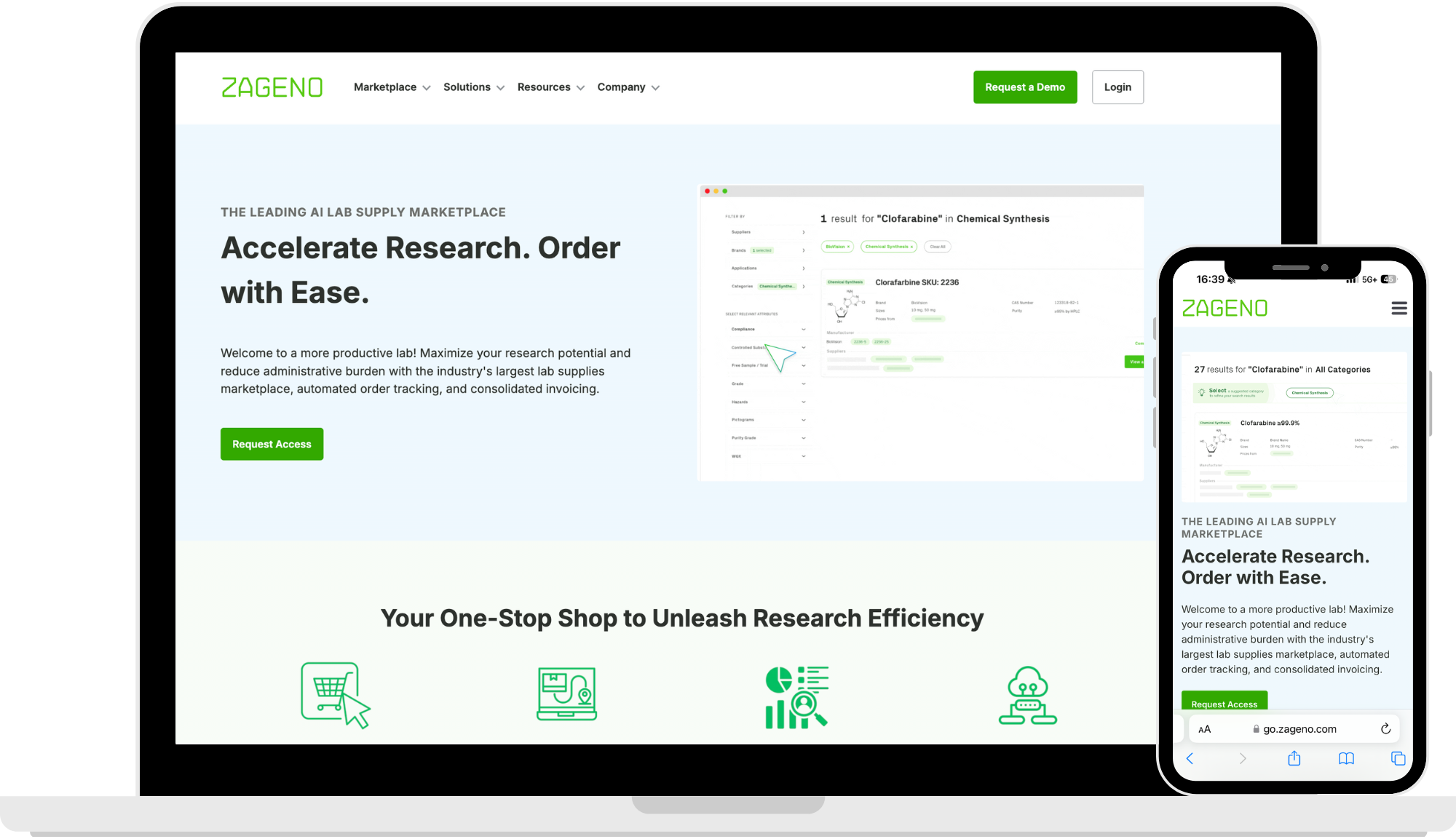
See how ZAGENO compares in action.
Related resources