
Procurement automation makes individual purchasing tasks faster. Procurement orchestration connects those tasks across people, suppliers, policies, data, and systems. That distinction is critical in pharmaceutical and biotech R&D, where purchasing delays directly impact experimental timelines.
Automating a purchase order or invoice cuts down on manual work, but it can’t ensure that researchers find the right product, follow supplier strategy, receive proper approvals, or transfer data cleanly between scientific and enterprise systems. Procurement orchestration solves this gap.
What is procurement automation?
Procurement automation uses technology to execute repetitive, predictable purchasing tasks with less manual effort.
Common examples include:
- Creating purchase orders automatically
- Routing approval requests based on price
- Matching invoices with purchase orders
- Transferring order data directly into an ERP
- Sending order confirmations
- Generating purchasing reports
While automation improves speed, consistency, and accuracy for standardized steps, scientific purchasing is rarely predictable. Researchers frequently require specialized products, equivalent alternatives, direct supplier quotes, compliance documents, or non-catalog items.
When exceptions happen, automation breaks down. Each non-standard order creates handoffs between scientists, Research Operations, procurement, finance, and suppliers.
What is procurement orchestration?
Applied to pharmaceutical and biotech R&D, Scientific Procurement Orchestration bridges scientific requirements with product discovery, preferred supplier access, purchasing policies, approvals, financial systems, and order fulfillment.
Instead of treating procurement as an external administrative process, orchestration embeds purchasing directly into the lab environment.
Whether a researcher begins inside an ELN, LIMS, inventory system, or enterprise AI assistant, an orchestrated process can seamlessly:
- Interpret what the researcher needs.
- Search a unified, harmonized scientific catalog.
- Apply preferred supplier rules and category strategies.
- Route any necessary approvals dynamically.
- Transfer the order into the P2P or ERP system.
- Return real-time status and delivery updates to the appropriate users and systems.
Procurement automation vs. procurement orchestration: Key differences
| Dimension | Procurement automation | Procurement orchestration |
|---|---|---|
| Primary purpose | Complete repetitive tasks faster | Coordinate the entire purchasing ecosystem |
| Scope | Individual tasks or isolated workflows | End-to-end processes, systems, teams, and handoffs |
| System model | Often operates within a single application | Connects scientific tools with enterprise applications |
| Supplier strategy | Automates transactions with pre-configured suppliers | Applies preferred suppliers and category strategy at the point of search |
| Exceptions | Requires manual intervention | Intelligently routes exceptions through governed workflows |
| Data integrity | Passes raw data between defined fields | Harmonizes scientific and financial data across platforms |
| Role of AI | Automates task execution or basic recommendations | Guides decisions inside connected, governed workflows |
| Researcher impact | Cuts administrative steps | Embeds compliant procurement directly into scientific work |
| Business outcome | Greater local task efficiency | End-to-end visibility, control, and research continuity |
The practical difference is clearest when an order diverges from the standard path. While an automated system simply routes a pre-selected item for approval, an orchestrated system supports the decisions that come first: identifying a suitable product, enforcing preferred vendor agreements during search, and ensuring consistent data flows through to fulfillment.
Why automation alone falls short in pharma R&D
Pharma R&D involves far more complexity than standard indirect procurement. Scientists routinely source reagents, custom antibodies, specialized lab equipment, controlled materials, custom products, and items with precise technical specifications.
Complexity compounds when teams span multiple sites, supplier portals, P2P platforms, ERPs, inventory management tools, and ELNs. Automating isolated steps leaves the larger process fragmented:
- Approval routing may be automated, while product discovery happens across multiple supplier websites.
- A purchase order may be created automatically, while supplier data remains inconsistent.
- Invoice matching may be automated, while nonstandard orders require manual investigation.
- A P2P system may enforce policy without understanding the scientific context behind a request.
- An AI assistant may recommend a product without access to current pricing, availability, supplier agreements, or procurement policies.
This disconnect explains why heavy tech investments often fail to scale. Deloitte found that only 22% of life sciences leaders had successfully scaled AI, while just 9% reported significant returns. The findings highlight the need for connected data, workflows, and operating models, not simply more tools.
Where automation stops and orchestration begins
Consider a scientist who needs a specific antibody for an upcoming experiment.
With standard automation: The researcher searches vendor websites manually, selects an item, enters the details into a procurement portal, and submits a requisition. The system then automates approval routing and PO generation.
Several important decisions still happen outside that workflow:
- Is this the correct product for the intended application?
- Is an equivalent available from a preferred supplier?
- Does the quoted price reflect the negotiated discounts?
- Can the product arrive before the experiment begins?
- Does the request follow purchasing and category policies?
- Is suitable inventory already available?
With orchestration: These decisions are brought directly into the workflow before the order is submitted. Real-time product data, supplier strategies, compliance rules, inventory levels, and approval paths converge in real time.
This enables guided buying for scientific procurement, steering researchers to the right products and preferred suppliers automatically without requiring them to interpret procurement rules.
How procurement orchestration works in pharma R&D
Scientific procurement sits between two environments that have traditionally operated separately. The scientific environment includes ELNs, LIMS, inventory systems, laboratory workflows, research data, and AI assistants. The enterprise environment includes P2P platforms, ERP systems, approval policies, supplier records, and financial controls.
Lab procurement integrations allow information to move between these environments, making dedicated pharma lab procurement solutions essential for connecting scientific context with financial controls.
How AI changes procurement automation and orchestration
AI can improve both automation and orchestration, but its role differs in each model.
- In an automated workflow: AI handles isolated tasks like extracting invoice details, tagging spend categories, or flagging data errors.
- In an orchestrated workflow: AI leverages connected, multi-system data to make end-to-end decisions.
For example, a researcher can describe an experimental scientific need in natural language. An AI-driven workflow could identify relevant products, prioritize preferred suppliers, account for purchasing rules, and route the request through the correct approval and ordering path.
This is increasingly important as AI becomes embedded in enterprise software. Gartner predicts that 40% of enterprise applications will include task-specific AI agents by the end of 2026, compared with less than 5% in 2025. Without an orchestrated layer supplying structured data and clear business logic, AI agents risk automating isolated steps without driving meaningful outcomes.
Learn more about AI in lab procurement.
7 signs your organization needs procurement orchestration
You may need to move beyond standard task automation if:
[ ] Scientists routinely exit procurement systems to find products on supplier sites.
[ ] Different sites, departments, or labs follow divergent purchasing procedures.
[] Preferred supplier terms are difficult to enforce during initial product search.
[ ] Spend data is fragmented across spreadsheets, vendor portals, and ERPs.
[ ] Order exceptions depend heavily on manual email chains.
[ ] Researchers cannot track order status inside their day-to-day tools.
[ ] Upgrading one software system consistently creates manual work elsewhere.
If you checked off at least one of the above gaps, it doesn’t mean your current tools failed; it simply indicates that your automated steps need to be connected into a cohesive process.
How to transition from automation to orchestration
Transitioning to orchestration does not require replacing your current software infrastructure. Instead, orchestration acts as an integrated layer across your existing technology stack.
- Map the entire request-to-delivery path: Identify where researchers manually re-enter data, wait on offline approvals, or consult external vendor websites.
- Move business decisions upstream: Build rule sets for preferred suppliers, alternative products, spending thresholds, and inventory checks into the initial search phase.
- Connect scientific and enterprise systems: Integrate lab software (ELNs/LIMS) directly with enterprise ERP and P2P platforms.
This unified approach preserves rigorous financial oversight while offering researchers an intuitive, scientific-first ordering experience.
For more guidance, see our strategic guide to life sciences procurement.
FAQs about procurement automation vs. procurement orchestration
- What is the primary difference between procurement automation and procurement orchestration?
Procurement automation completes individual tasks, such as routing approvals, creating purchase orders, and matching invoices. Procurement orchestration connects those automated tasks across people, suppliers, policies, data, and systems so the full process works as one coordinated workflow. - Is workflow automation the same as procurement orchestration?
No. Workflow automation moves a defined task or sequence forward according to established rules. Procurement orchestration coordinates multiple workflows and systems, including product search, supplier selection, approvals, ordering, receiving, and financial processing. - When does procurement automation become orchestration?
Automation becomes orchestration when individual automated tasks are connected across the complete purchasing process. Instead of optimizing one step, orchestration coordinates decisions and handoffs from the initial scientific need through ordering, delivery, and payment. - Does an organization still need orchestration if it already uses procurement automation?
It may. If researchers still move between disconnected systems, re-enter information, search supplier sites, or resolve exceptions manually, individual tasks may be automated without the overall process being connected. Orchestration addresses those gaps. - Can procurement automation and procurement orchestration work together?
Yes. Automation performs defined tasks within the larger orchestrated process. Orchestration determines how those tasks, systems, policies, and decisions work together to support scientific and business priorities.
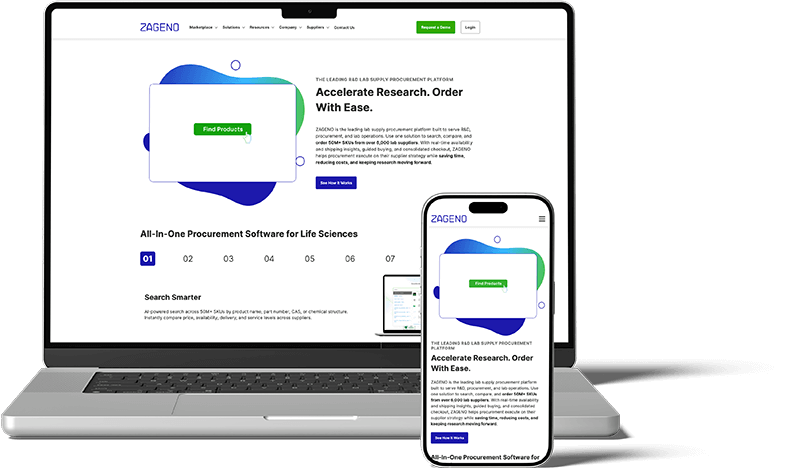
Orchestrate scientific procurement with ZAGENO
ZAGENO connects researchers, suppliers, procurement teams, finance, enterprise systems, and AI-enabled workflows within a single scientific procurement environment.
Ready to move beyond isolated task automation?
Request a personalized demo to see how Scientific Procurement Orchestration keeps your research moving forward.
Related resources