
Every day, pharmaceutical researchers lose valuable time waiting for purchasing approvals, switching between separate supplier portals, tracking order statuses, and chasing invoices. Together, these tasks create operational friction that slows critical experiments and limits visibility for procurement teams.
Purchasing must move at the speed of science while still meeting enterprise requirements for compliance and financial control. According to McKinsey’s analysis on strengthening the R&D operating model, improving R&D performance depends heavily on strengthening the operating infrastructure that supports scientific work—not just investing in new discovery technologies.
If your organization is focused on eliminating these administrative bottlenecks, optimizing your foundational life sciences research operations is the first step toward continuous experimental workflows.
What is intake to procure?
Intake to procure is the purchasing process that begins when someone identifies a need and continues through product discovery, supplier selection, policy checks, approvals, and an approved requisition. In pharmaceutical R&D, it must preserve exact product requirements, timing, compliance needs, and any limits on acceptable alternatives.
The procurement intake process turns that need into a structured request and sends it into the appropriate purchasing path. Done well, procurement intake reduces follow-up, guides researchers toward approved options, and keeps scientific context attached to the request.
Why lab purchasing becomes a bottleneck
Modern pharmaceutical organizations regularly purchase from hundreds or thousands of distinct manufacturers and distributors. Without a unified approach, this environment becomes highly fragmented. These complex friction points are explored in our guide to navigating modern pharma procurement challenges.
A fragmented procurement intake process can force researchers to submit incomplete requests, compare suppliers manually, sign in to separate websites, navigate multilevel approvals, and resolve missing information through email.
What does the intake-to-procure process include?
An efficient intake-to-procure process connects the initial scientific need with product discovery, supplier selection, purchasing rules, and approvals. It then passes a complete, approved request into the organization’s procure-to-pay systems.
Connecting these activities reduces repeated data entry and preserves the scientific, supplier, and financial information captured during procurement intake.
For the complete process beyond request intake, our guide to lab supply purchasing for pharma and biotech covers product selection, approvals, ordering, receiving, and invoice reconciliation.
Eight ways to streamline lab purchasing
Unifying operations via procurement orchestration
Many growing organizations attempt to fix purchasing piecemeal—automating approval matrices, plugging in a punch-out catalog, or syncing an ERP module independently. While each standalone project provides isolated value, they ultimately leave the underlying infrastructure highly disjointed.
The next frontier of operational maturity is bringing these disparate layers together into a unified strategy known as procurement orchestration. Procurement orchestration synchronizes multi-vendor supply networks, internal approval hierarchies, deep AI capabilities, and financial systems directly into live scientific workflows.
When evaluating who offers procurement orchestration explicitly tailored to the rigorous demands of pharmaceutical and biotech R&D, specialized software integrations provide a scalable path forward. Platforms like ZAGENO act as the connective orchestration layer that unifies scientific intent with enterprise controls, helping labs return thousands of hours back to active research while maintaining total compliance.
To explore how top-tier research institutions scale their purchasing structures using this methodology, check out our insights on how research operations infrastructure builds productivity.
Beyond transactional purchasing: The path forward
Streamlining lab purchasing isn't about moving approvals faster or introducing another finance app. It's about eliminating operational friction from the entire research lifecycle. When scientists can quickly locate products, compare global suppliers, receive instant automated approvals, and track order logistics through an integrated dashboard, breakthrough science moves faster.
To discover how modern biotech and pharma enterprises build these scalable environments, check out our comprehensive guide to picking a lab supply marketplace.
Ready to orchestrate your lab procurement?
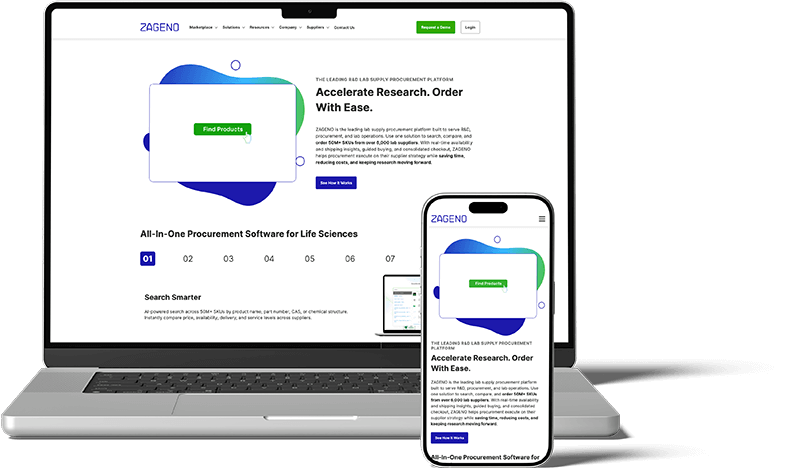
Manual purchasing workflows shouldn't dictate the pace of your scientific discovery. Discover how ZAGENO unifies multi-vendor catalogs, internal compliance rules, and enterprise ERP integrations into a single, intuitive scientific workflow.
Eliminate operational bottlenecks—Request a ZAGENO demo today.
Frequently Asked Questions
- How can pharmaceutical companies streamline lab purchasing?
Companies can streamline lab purchasing by centralizing supplier access through a digital marketplace, automating approval workflows, integrating purchasing with native scientific tools (ELNs/LIMS), and using AI to simplify product discovery and item comparisons. - How is intake to procure different from procure to pay?
Intake to procure focuses on the beginning of the purchasing process: capturing a need, identifying the right product and supplier, applying purchasing policies, and routing the request for approval. Procure to pay covers the transactional activities that follow, including purchase-order processing, receiving, invoice matching, and payment. Connecting the two allows information captured during procurement intake to flow into ERP and P2P systems without being entered again. - What causes experiment delays from lab supply problems, and how do you fix them?
Experiment delays are typically caused by supply chain fragmentation, manual spec verification, and slow approval workflows. You can fix this by centralizing multi-vendor catalogs into a unified marketplace that automates routing controls and provides real-time inventory visibility. - How can a preclinical organization improve reagent supply continuity?
Preclinical organizations can maximize continuity by utilizing an orchestrated procurement platform that displays alternative, equivalent products from multiple vendors side-by-side, allowing researchers to quickly pivot if a primary choice faces sudden stockouts. - How do pharma labs manage reagent provenance and reproducibility?
Labs manage provenance by executing orders through a centralized procurement tracking layer that archives precise manufacturer details, batch histories, and item specifications, ensuring that any biological material utilized can be exactly replicated in future clinical stages. - What is procurement orchestration in life sciences, and who offers it?
Procurement orchestration is the automated synchronization of multi-vendor supply chains, corporate compliance policies, enterprise finance systems, and laboratory workflows into a single experience. Platforms like ZAGENO specialize in delivering procurement orchestration engineered specifically for biotechnology and pharmaceutical R&D environments.
Related resources