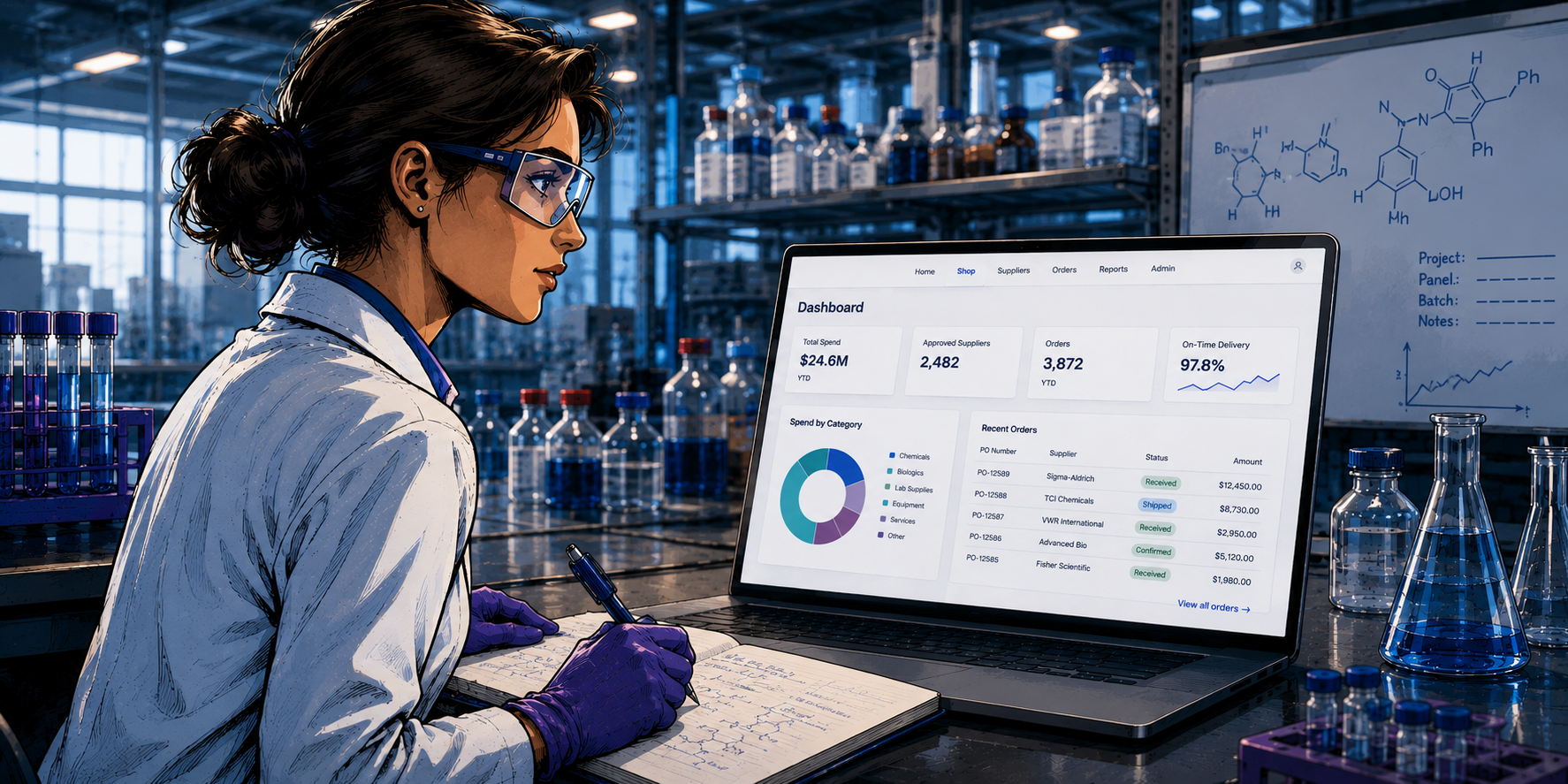
Pharmaceutical procurement has become significantly more complex over the past decade. As organizations scale globally, pharma procurement teams are expected to balance cost control, supplier governance, compliance requirements, and research velocity simultaneously.
However, many organizations still rely on disparate purchasing workflows spread across spreadsheets, disconnected supplier systems, and legacy procurement tools. The result is often a growing procurement traceability gap: purchasing activity, approvals, supplier communication, and fulfillment records become difficult to track consistently across the organization.
For regulated environments, that creates more than operational inefficiency. It creates compliance risk. Modern pharma procurement compliance is no longer just about documentation or audit preparation. Increasingly, it depends on connected procurement infrastructure that supports governance, supplier management, and scientific execution simultaneously.
In regulated life sciences environments, procurement activity often intersects with broader GxP requirements related to:
- Traceability
- Documentation integrity
- Approved suppliers
- Audit readiness
- Purchasing controls
- Financial reconciliation
- Procurement policy enforcement
This becomes particularly important when procurement activity spans multiple business units, global suppliers, contract manufacturers, and decentralized purchasing processes. As discussed in ZAGENO’s guide to life sciences procurement, procurement is increasingly becoming a strategic operational function rather than a purely transactional process.
When procurement systems become too slow or disconnected from day-to-day research activity, researchers often create workarounds that introduce additional visibility and compliance challenges later.Many of these issues overlap with broader pharma procurement challenges related to supplier sprawl, procurement visibility, and operational complexity across R&D environments.
The growing procurement traceability gap
One of the biggest operational risks facing pharmaceutical procurement teams today is the procurement traceability gap. This gap occurs when purchasing activity, approvals, supplier communication, and fulfillment records are spread across disconnected systems, making it difficult to maintain centralized visibility and audit readiness.
In many pharma organizations, procurement compliance challenges are amplified when ERP, P2P, supplier, and purchasing systems operate independently without shared visibility.
This gap often grows as organizations scale.
A global pharma company may manage:
- Tens of thousands of suppliers
- Multiple ERP systems
- Decentralized procurement teams
- Varying approval structures
- Regional purchasing requirements
- Contract research organizations (CROs)
- Clinical and preclinical purchasing environments
Without centralized procurement visibility, organizations may struggle to answer basic operational questions quickly:
- Was this supplier approved?
- Who authorized this purchase?
- Was the purchase compliant with procurement policy?
- Where is the audit trail?
What audit-ready procurement workflows look like in practice
Audit-ready procurement workflows are designed to create consistent visibility, traceability, and governance throughout the purchasing lifecycle. For many pharma organizations, procurement is evolving into an operational execution layer that connects suppliers, approvals, and ERP systems.
Essential components of compliant infrastructure
|
Workflow Component |
Impact on Compliance & Governance |
|---|---|
|
Centralized Supplier Consolidation |
Single entry point standardizes supplier governance and helps steer buyers toward preferred suppliers. |
|
Automated Approval Routing |
Eliminates email-based gaps with timestamped, role-based purchasing permissions. |
|
Integrated ERP Synchronization |
Improves consistency between purchasing activity, financial records, and supplier data. |
|
Consolidated Reporting |
Provides complete purchasing histories and real-time visibility to support audit preparation. |
|
AI-Driven Sourcing Support |
Helps improve supplier decisions while reducing manual coordination across teams. |
How modern procurement platforms support GxP-aligned operations
Modern procurement platforms are increasingly designed to support the operational requirements of regulated R&D environments. That does not mean procurement software replaces quality systems, validation programs, or broader compliance infrastructure.
Instead, modern procurement systems help operationalize compliant purchasing workflows through centralized visibility, enhanced supplier governance, audit-ready documentation, connected, controlled purchasing infrastructure, and standardized, automated processes.
Platforms that integrate with ERP and procure-to-pay systems can also help improve consistency between purchasing activity, financial records, supplier data, and approval workflows.
Increasingly, organizations are also embedding AI-driven procurement insights directly into sourcing and purchasing workflows to improve supplier decisions, accelerate procurement cycles, and reduce manual coordination across teams.
As highlighted in Life Sciences Review’s coverage of connected procurement operations, leading pharma organizations are increasingly focused on embedding procurement into the rhythm of scientific work rather than treating it as a disconnected back-office process. Connected procurement infrastructure helps align sourcing, supplier management, approvals, and operational visibility more closely with the pace of modern R&D.
What to look for in pharmaceutical procurement software
Pharmaceutical organizations evaluating procurement platforms should look beyond basic purchasing functionality.
The strongest procurement systems support connected, audit-ready operations across suppliers, finance, procurement, and R&D teams. That means improving visibility and governance without creating additional complexity for scientists or slowing down research workflows.
At a minimum, modern pharmaceutical procurement software should help organizations:
- Centralize supplier and purchasing activity
- Improve procurement traceability and approval visibility
- Connect procurement workflows with ERP and P2P systems
- Support supplier governance and audit readiness
- Reduce manual coordination across teams
As procurement environments become more complex, disconnected purchasing systems become increasingly difficult to manage at enterprise scale. Modern procurement infrastructure helps pharma organizations improve visibility, governance, and operational consistency while supporting the pace of scientific execution.
The future of pharma procurement compliance
The organizations best positioned for the future will be those that treat procurement not as a back-office purchasing function, but as operational infrastructure supporting modern scientific execution. Compliance, visibility, supplier governance, and research velocity are no longer separate priorities; increasingly, they depend on the same connected procurement foundation
Frequently asked questions (FAQ) about pharma procurement compliance
- What is pharma procurement compliance?
Pharma procurement compliance refers to the processes, controls, supplier governance practices, and documentation standards that help pharmaceutical organizations maintain traceable, audit-ready purchasing workflows. - What does audit-ready procurement mean in pharma?
Audit-ready procurement means procurement workflows are structured so organizations can easily track approvals, supplier usage, purchasing records, invoices, receipts, and procurement activity during internal or external audits. - How do pharma companies improve procurement traceability?
Pharma companies often improve procurement traceability by centralizing purchasing workflows, integrating procurement systems with ERP platforms, standardizing supplier governance, and automating approval and documentation processes. - How does procurement software support GxP compliance?
Procurement software can support GxP-aligned operations by improving purchasing visibility, audit trails, approval consistency, supplier governance, and procurement documentation management. - Why is supplier governance important in pharmaceutical procurement?
Supplier governance helps pharmaceutical organizations maintain consistency, reduce procurement risk, improve compliance visibility, and ensure purchasing aligns with approved supplier strategies and operational requirements.
Build a more compliant and connected procurement workflow
ZAGENO helps pharma and life sciences organizations centralize purchasing workflows, improve supplier governance, and support audit-ready operations across global R&D environments, without slowing down science.
Related resources